How to complete the Advisory & Risk Control Agreement

Please complete

  • Page 7 Risk Control Agreement
  • Page 8, Acknowledgment  2 Signatures
  • Page 9, Non-US Acknowledgment
  • Return Completed Forms to peter_knight@peterknightadvisor.com
  • We’ll sign off and forward copies to you and the Brokerage Firm(s)

1)Defining overall risk for your Automated Trading Account (ATA)
(5 minutes 4 seconds)

  • Allows you to set a stop loss for your account based on the liquidation value of the account ( maintenance balance)
  • Should the account fall below the maintenance balance as of the settlement of any trading day our team will automatically liquidate all positions on or before the next close and report back to you.
  • If we fail to liquidate on or before the next settlement we are liable for any losses from that settlement forward
  • Trading Authorization is automatically revoked
  • Any new new positions from would be deemed unauthorized and transferred to the Asset Investment Management (AIM) error account immediately.

2) How Asset Investment Management incentive fees work (3 minutes 45 seconds)

  • AIM Advisory & Risk Control Agreement
  • 0.00% Front load
  • 0.00% Management fee
  • 12.50% Of net new high profits quarterly
  • Net new highs are calculated after all brokerage, exchange and reg. fees

If you have any questions send a message or contact me.

Regards,
Peter Knight Advisor


Privacy Notice

Disclosure

Risk Disclosure

Defining Account Risk

Program availability is dependent on your country of residence and financial status.

All must fully understand and acknowledge the substantial risk trading in any market using leverage, Stocks, ETFs, Mutual Funds, Forex, Futures or CFDs. Any funds invested if lost should not have a significant impact on one’s lifestyle.

The information provided in this report contains research, market commentary and trade recommendations, it should be known that representatives of our firm may trade for their own accounts or clients differently from the opinions and recommendations found in the reports on site due to various factors such as margin requirements, trading objectives, trading instructions the use of a different trading strategy.

Bid/ask spreads, commission, clearing, exchange and regulatory fees will have an adverse impact on the net overall performance of  any account, prior to making a decision to participate in any investment make sure you fully understand the fees associated with trading.

Examples of historic price moves or extreme market conditions are not meant to imply that such moves or conditions are common occurrences.

Actual past performance is not necessarily indicative of future performance. No representation is being made that any account will or is likely to achieve future profits or losses similar to those shown.

Hypothetical performance results have many inherent limitations, some of which are described below. No representation is being made that any account will or is  likely to achieve profits or losses similar to those shown. In fact, there are frequently sharp differences between hypothetical performance results and the actual results subsequently achieved by any particular trading program. One of the limitations of hypothetical performance results is that they are generally prepared with the benefit of hindsight. In addition, hypothetical trading does not involve financial risk, and no hypothetical trading record can completely account for the impact of financial risk in actual trading. For example, the ability to withstand losses or adhere to a particular trading program in spite of trading losses are material points which can also adversely affect actual trading results. There are numerous other factors related to the markets in general or to the implementation of any specific trading program which cannot be fully accounted for in the preparation of hypothetical performance results and all of which can adversely affect actual trading results.

  • Trading security futures contracts involves risk and may result in potentially unlimited losses that are greater than the amount you deposited with your broker. As with any high risk financial product, you should not risk any funds that you cannot afford to lose, such as your retirement savings, medical and other emergency funds, funds set aside for purposes such as education or home ownership, proceeds from student loans or mortgages, or funds required to meet your living expenses.
  • Be cautious of claims that you can make large profits from trading security futures contracts. Although the high degree of leverage in security futures contracts can result in large and immediate gains, it can also result in large and immediate losses. As with any financial product, there is no such thing as a “sure winner.”
  • Because of the leverage involved and the nature of security futures contract transactions, you may feel the effects of your losses immediately. Gains and losses in security futures contracts are credited or debited to your account, at a minimum, on a daily basis. If movements in the markets for security futures contracts or the underlying security decrease the value of your positions in security futures contracts, you may be required to have or make additional funds available to your carrying firm as margin. If your account is under the minimum margin requirements set by the exchange or the brokerage firm, your position may be liquidated at a loss, and you will be liable for the deficit, if any, in your account. Margin requirements are addressed in Section 4.
  • Under certain market conditions, it may be difficult or impossible to liquidate a position. Generally, you must enter into an offsetting transaction in order to liquidate a position in a security futures contract. If you cannot liquidate your position in security futures contracts, you may not be able to realize a gain in the value of your position or prevent losses from mounting. This inability to liquidate could occur, for example, if trading is halted due to unusual trading activity in either the security futures contract or the underlying security; if trading is halted due to recent news events involving the issuer of the underlying security; if systems failures occur on an exchange or at the firm carrying your position; or if the position is on an illiquid market. Even if you can liquidate your position, you may be forced to do so at a price that involves a large loss.
  • Under certain market conditions, it may also be difficult or impossible to manage your risk from open security futures positions by entering into an equivalent but opposite position in another contract month, on another market, or in the underlying security. This inability to take positions to limit your risk could occur, for example, if trading is halted across markets due to unusual trading activity in the security futures contract or the underlying security or due to recent news events involving the issuer of the underlying security.
  • Under certain market conditions, the prices of security futures contracts may not maintain their customary or anticipated relationships to the prices of the underlying security or index. These pricing disparities could occur, for example, when the market for the security futures contract is illiquid, when the primary market for the underlying security is closed, or when the reporting of transactions in the underlying security has been delayed. For index products, it could also occur when trading is delayed or halted in some or all of the securities that make up the index.
  • You may be required to settle certain security futures contracts with physical delivery of the underlying security. If you hold your position in a physically settled security futures contract until the end of the last trading day prior to expiration, you will be obligated to make or take delivery of the underlying securities, which could involve additional costs. The actual settlement terms may vary from contract to contract and exchange to exchange. You should carefully review the settlement and delivery conditions before entering into a security futures contract. Settlement and delivery are discussed in Section 5.
  • You may experience losses due to systems failures. As with any financial transaction, you may experience losses if your orders for security futures contracts cannot be executed normally due to systems failures on a regulated exchange or at the brokerage firm carrying your position. Your losses may be greater if the brokerage firm carrying your position does not have adequate back-up systems or procedures.
  • All security futures contracts involve risk, and there is no trading strategy that can eliminate it. Strategies using combinations of positions, such as spreads, may be as risky as outright long or short positions. Trading in security futures contracts requires knowledge of both the securities and the futures markets.
  • Day trading strategies involving security futures contracts and other products pose special risks. As with any financial product, persons who seek to purchase and sell the same security future in the course of a day to profit from intra-day price movements (“day traders”) face a number of special risks, including substantial commissions, exposure to leverage, and competition with professional traders. You should thoroughly understand these risks and have appropriate experience before engaging in day trading. The special risks for day traders are discussed more fully in Section 7.
  • Placing contingent orders, if permitted, such as “stop-loss” or “stop-limit” orders, will not necessarily limit your losses to the intended amount. Some regulated exchanges may permit you to enter into stop-loss or stop-limit orders for security futures contracts, which are intended to limit your exposure to losses due to market fluctuations. However, market conditions may make it impossible to execute the order or to get the stop price.
  • You should thoroughly read and understand the customer account agreement with your brokerage firm before entering into any transactions in security futures contracts.
  • You should thoroughly understand the regulatory protections available to your funds and positions in the event of the failure of your brokerage firm. The regulatory protections available to your funds and positions in the event of the failure of your brokerage firm may vary depending on, among other factors, the contract you are trading and whether you are trading through a securities account or a futures account. Firms that allow customers to trade security futures in either securities accounts or futures accounts, or both, are required to disclose to customers the differences in regulatory protections between such accounts, and, where appropriate, how customers may elect to trade in either type of account.
Section 2 – Description of a Security Futures Contract


2.1. What is a Security Futures Contract?

A security futures contract is a legally binding agreement between two parties to purchase or sell in the future a specific quantity of shares of a security or of the component securities of a narrow-based security index, at a certain price. A person who buys a security futures contract enters into a contract to purchase an underlying security and is said to be “long” the contract. A person who sells a security futures contract enters into a contract to sell the underlying security and is said to be “short” the contract. The price at which the contract trades (the “contract price”) is determined by relative buying and selling interest on a regulated exchange.

In order to enter into a security futures contract, you must deposit funds with your brokerage firm equal to a specified percentage (usually at least 20 percent) of the current market value of the contract as a performance bond. Moreover, all security futures contracts are marked-to-market at least daily, usually after the close of trading, as described in Section 3 of this document. At that time, the account of each buyer and seller reflects the amount of any gain or loss on the security futures contract based on the contract price established at the end of the day for settlement purposes (the “daily settlement price”).

An open position, either a long or short position, is closed or liquidated by entering into an offsetting transaction (i.e., an equal and opposite transaction to the one that opened the position) prior to the contract expiration. Traditionally, most futures contracts are liquidated prior to expiration through an offsetting transaction and, thus, holders do not incur a settlement obligation.

Examples:

    • Investor A is long one September XYZ Corp. futures contract. To liquidate the long position in the September XYZ Corp. futures contract, Investor A would sell an identical September XYZ Corp. contract.


    Investor B is short one December XYZ Corp. futures contract. To liquidate the short position in the December XYZ Corp. futures contract, Investor B would buy an identical December XYZ Corp. contract.

Security futures contracts that are not liquidated prior to expiration must be settled in accordance with the terms of the contract. Some security futures contracts are settled by physical delivery of the underlying security. At the expiration of a security futures contract that is settled through physical delivery, a person who is long the contract must pay the final settlement price set by the regulated exchange or the clearing organization and take delivery of the underlying shares. Conversely, a person who is short the contract must make delivery of the underlying shares in exchange for the final settlement price.

Other security futures contracts are settled through cash settlement. In this case, the underlying security is not delivered. Instead, any positions in such security futures contracts that are open at the end of the last trading day are settled through a final cash payment based on a final settlement price determined by the exchange or clearing organization. Once this payment is made, neither party has any further obligations on the contract.

Physical delivery and cash settlement are discussed more fully in Section 5.

2.2. Purposes of Security Futures
Security futures contracts can be used for speculation, hedging, and risk management. Security futures contracts do not provide capital growth or income.

Speculation

Speculators are individuals or firms who seek to profit from anticipated increases or decreases in futures prices. A speculator who expects the price of the underlying instrument to increase will buy the security futures contract. A speculator who expects the price of the underlying instrument to decrease will sell the security futures contract. Speculation involves substantial risk and can lead to large losses as well as profits.

The most common trading strategies involving security futures contracts are buying with the hope of profiting from an anticipated price increase and selling with the hope of profiting from an anticipated price decrease. For example, a person who expects the price of XYZ stock to increase by March can buy a March XYZ security futures contract, and a person who expects the price of XYZ stock to decrease by March can sell a March XYZ security futures contract. The following illustrates potential profits and losses if Customer A purchases the security futures contract at $50 a share and Customer B sells the same contract at $50 a share (assuming 100 shares per contract).

Price of XYZ at Liquidation Customer A Profit/Loss Customer B Profit/Loss

$55 $500 – $500
$50 0 0
$45 – $500 $500


Speculators may also enter into spreads with the hope of profiting from an expected change in price relationships. Spreaders may purchase a contract expiring in one contract month and sell another contract on the same underlying security expiring in a different month (e.g., buy June and sell September XYZ single stock futures). This is commonly referred to as a “calendar spread.”

Spreaders may also purchase and sell the same contract month in two different but economically correlated security futures contracts. For example, if ABC and XYZ are both pharmaceutical companies and an individual believes that ABC will have stronger growth than XYZ between now and June, he could buy June ABC futures contracts and sell June XYZ futures contracts. Assuming that each contract is 100 shares, the following illustrates how this works.

Opening Position Price at Liquidation Gain or Loss Price at Liquidation Gain or Loss

Buy ABC at 50 $50 $300 53 $300
Sell XYZ at 45 $46 – $100 $50 – $500
Net Gain or Loss $200   – $200

Speculators can also engage in arbitrage, which is similar to a spread except that the long and short positions occur on two different markets. An arbitrage position can be established by taking an economically opposite position in a security futures contract on another exchange, in an options contract, or in the underlying security.

Hedging

Generally speaking, hedging involves the purchase or sale of a security future to reduce or offset the risk of a position in the underlying security or group of securities (or a close economic equivalent). A hedger gives up the potential to profit from a favorable price change in the position being hedged in order to minimize the risk of loss from an adverse price change.

An investor who wants to lock in a price now for an anticipated sale of the underlying security at a later date can do so by hedging with security futures. For example, assume an investor owns 1,000 shares of ABC that have appreciated since he bought them. The investor would like to sell them at the current price of $50 per share, but there are tax or other reasons for holding them until September. The investor could sell ten 100-share ABC futures contracts and then buy back those contracts in September when he sells the stock. Assuming the stock price and the futures price change by the same amount, the gain or loss in the stock will be offset by the loss or gain in the futures contracts.

Price in
September
Value of 1,000
Shares of ABC
Gain or Loss
on Futures
Effective
Selling Price
$40 $40,000 $10,000 $50,000
$50 $50,000 $ 0 $50,000
$60 $60,000 -$10,000 $50,000

Hedging can also be used to lock in a price now for an anticipated purchase of the stock at a later date. For example, assume that in May a mutual fund expects to buy stocks in a particular industry with the proceeds of bonds that will mature in August. The mutual fund can hedge its risk that the stocks will increase in value between May and August by purchasing security futures contracts on a narrow-based index of stocks from that industry. When the mutual fund buys the stocks in August, it also will liquidate the security futures position in the index. If the relationship between the security futures contract and the stocks in the index is constant, the profit or loss from the futures contract will offset the price change in the stocks, and the mutual fund will have locked in the price that the stocks were selling at in May.

Although hedging mitigates risk, it does not eliminate all risk. For example, the relationship between the price of the security futures contract and the price of the underlying security traditionally tends to remain constant over time, but it can and does vary somewhat. Furthermore, the expiration or liquidation of the security futures contract may not coincide with the exact time the hedger buys or sells the underlying stock. Therefore, hedging may not be a perfect protection against price risk.

Risk Management
Some institutions also use futures contracts to manage portfolio risks without necessarily intending to change the composition of their portfolio by buying or selling the underlying securities. The institution does so by taking a security futures position that is opposite to some or all of its position in the underlying securities. This strategy involves more risk than a traditional hedge because it is not meant to be a substitute for an anticipated purchase or sale.

2.3. Where Security Futures Trade
By law, security futures contracts must trade on a regulated U.S. exchange. Each regulated U.S. exchange that trades security futures contracts is subject to joint regulation by the Securities and Exchange Commission (SEC) and the Commodity Futures Trading Commission (CFTC).

A person holding a position in a security futures contract who seeks to liquidate the position must do so either on the regulated exchange where the original trade took place or on another regulated exchange, if any, where a fungible security futures contract trades. (A person may also seek to manage the risk in that position by taking an opposite position in a comparable contract traded on another regulated exchange.)

Security futures contracts traded on one regulated exchange might not be fungible with security futures contracts traded on another regulated exchange for a variety of reasons. Security futures traded on different regulated exchanges may be non-fungible because they have different contract terms (e.g., size, settlement method), or because they are cleared through different clearing organizations. Moreover, a regulated exchange might not permit its security futures contracts to be offset or liquidated by an identical contract traded on another regulated exchange, even though they have the same contract terms and are cleared through the same clearing organization. You should consult your broker about the fungibility of the contract you are considering purchasing or selling, including which exchange(s), if any, on which it may be offset.

Regulated exchanges that trade security futures contracts are required by law to establish certain listing standards. Changes in the underlying security of a security futures contract may, in some cases, cause such contract to no longer meet the regulated exchange’s listing standards. Each regulated exchange will have rules governing the continued trading of security futures contracts that no longer meet the exchange’s listing standards. These rules may, for example, permit only liquidating trades in security futures contracts that no longer satisfy the listing standards.

2.4. How Security Futures Differ from the Underlying Security
Shares of common stock represent a fractional ownership interest in the issuer of that security. Ownership of securities confers various rights that are not present with positions in security futures contracts. For example, persons owning a share of common stock may be entitled to vote in matters affecting corporate governance. They also may be entitled to receive dividends and corporate disclosure, such as annual and quarterly reports.

The purchaser of a security futures contract, by contrast, has only a contract for future delivery of the underlying security. The purchaser of the security futures contract is not entitled to exercise any voting rights over the underlying security and is not entitled to any dividends that may be paid by the issuer. Moreover, the purchaser of a security futures contract does not receive the corporate disclosures that are received by shareholders of the underlying security, although such corporate disclosures must be made publicly available through the SEC’s EDGAR system, which can be accessed at http://www.sec.gov. You should review such disclosures before entering into a security futures contract. See Section 8.1 for further discussion of the impact of corporate events on a security futures contract.

All security futures contracts are marked-to-market at least daily, usually after the close of trading, as described in Section 3 of this document. At that time, the account of each buyer and seller is credited with the amount of any gain, or debited by the amount of any loss, on the security futures contract, based on the contract price established at the end of the day for settlement purposes (the “daily settlement price”). By contrast, the purchaser or seller of the underlying instrument does not have the profit and loss from his or her investment credited or debited until the position in that instrument is closed out.

Naturally, as with any financial product, the value of the security futures contract and of the underlying security may fluctuate. However, owning the underlying security does not require an investor to settle his or her profits and losses daily. By contrast, as a result of the mark-to-market requirements discussed above, a person who is long a security futures contract often will be required to deposit additional funds into his or her account as the price of the security futures contract decreases. Similarly, a person who is short a security futures contract often will be required to deposit additional funds into his or her account as the price of the security futures contract increases.

Another significant difference is that security futures contracts expire on a specific date. Unlike an owner of the underlying security, a person cannot hold a long position in a security futures contract for an extended period of time in the hope that the price will go up. If you do not liquidate your security futures contract, you will be required to settle the contract when it expires, either through physical delivery or cash settlement. For cash-settled contracts in particular, upon expiration, an individual will no longer have an economic interest in the securities underlying the security futures contract.

2.5. Comparison to Options
Although security futures contracts share some characteristics with options on securities (options contracts), these products are also different in a number of ways. Below are some of the important distinctions between equity options contracts and security futures contracts.

If you purchase an options contract, you have the right, but not the obligation, to buy or sell a security prior to the expiration date. If you sell an options contract, you have the obligation to buy or sell a security prior to the expiration date. By contrast, if you have a position in a security futures contract (either long or short), you have both the right and the obligation to buy or sell a security at a future date. The only way that you can avoid the obligation incurred by the security futures contract is to liquidate the position with an offsetting contract.

A person purchasing an options contract runs the risk of losing the purchase price (premium) for the option contract. Because it is a wasting asset, the purchaser of an options contract who neither liquidates the options contract in the secondary market nor exercises it at or prior to expiration will necessarily lose his or her entire investment in the options contract. However, a purchaser of an options contract cannot lose more than the amount of the premium. Conversely, the seller of an options contract receives the premium and assumes the risk that he or she will be required to buy or sell the underlying security on or prior to the expiration date, in which event his or her losses may exceed the amount of the premium received. Although the seller of an options contract is required to deposit margin to reflect the risk of its obligation, he or she may lose many times his or her initial margin deposit.

By contrast, the purchaser and seller of a security futures contract each enter into an agreement to buy or sell a specific quantity of shares in the underlying security. Based upon the movement in prices of the underlying security, a person who holds a position in a security futures contract can gain or lose many times his or her initial margin deposit. In this respect, the benefits of a security futures contract are similar to the benefits of purchasing an option, while the risks of entering into a security futures contract are similar to the risks of selling an option.

Both the purchaser and the seller of a security futures contract have daily margin obligations. At least once each day, security futures contracts are marked-to-market and the increase or decrease in the value of the contract is credited or debited to the buyer and the seller. As a result, any person who has an open position in a security futures contract may be called upon to meet additional margin requirements or may receive a credit of available funds.

Example:

    • Assume that Customers A and B each anticipate an increase in the market price of XYZ stock, which is currently $50 a share. Customer A purchases an XYZ 50 call (covering 100 shares of XYZ at a premium of $5 per share). The option premium is $500 ($5 per share X 100 shares). Customer B purchases an XYZ security futures contract (covering 100 shares of XYZ). The total value of the contract is $5000 ($50 share value X 100 shares). The required margin is $1000 (or 20% of the contract value).
Price of
XYZ at
expiration
Customer A
Profit/Loss
Customer B
Profit/Loss
65 1000 1500
60 500 1000
55 0 500
50 -500 0
45 -500 -500
40 -500 -1000
35 -500 -1500

The most that Customer A can lose is $500, the option premium. Customer A breaks even at $55 per share, and makes money at higher prices. Customer B may lose more than his initial margin deposit. Unlike the options premium, the margin on a futures contract is not a cost but a performance bond. The losses for Customer B are not limited by this performance bond. Rather, the losses or gains are determined by the settlement price of the contract, as provided in the example above. Note that if the price of XYZ falls to $35 per share, Customer A loses only $500, whereas Customer B loses $1500.

2.6. Components of a Security Futures Contract
Each regulated exchange can choose the terms of the security futures contracts it lists, and those terms may differ from exchange to exchange or contract to contract. Some of those contract terms are discussed below. However, you should ask your broker for a copy of the contract specifications before trading a particular contract.

2.6.1. Each security futures contract has a set size. The size of a security futures contract is determined by the regulated exchange on which the contract trades. For example, a security futures contract for a single stock may be based on 100 shares of that stock. If prices are reported per share, the value of the contract would be the price times 100. For narrow-based security indices, the value of the contract is the price of the component securities times the multiplier set by the exchange as part of the contract terms.

2.6.2. Security futures contracts expire at set times determined by the listing exchange. For example, a particular contract may expire on a particular day, e.g., the third Friday of the expiration month. Up until expiration, you may liquidate an open position by offsetting your contract with a fungible opposite contract that expires in the same month. If you do not liquidate an open position before it expires, you will be required to make or take delivery of the underlying security or to settle the contract in cash after expiration.

2.6.3. Although security futures contracts on a particular security or a narrow-based security index may be listed and traded on more than one regulated exchange, the contract specifications may not be the same. Also, prices for contracts on the same security or index may vary on different regulated exchanges because of different contract specifications.

2.6.4. Prices of security futures contracts are usually quoted the same way prices are quoted in the underlying instrument. For example, a contract for an individual security would be quoted in dollars and cents per share. Contracts for indices would be quoted by an index number, usually stated to two decimal places.

2.6.5. Each security futures contract has a minimum price fluctuation (called a tick), which may differ from product to product or exchange to exchange. For example, if a particular security futures contract has a tick size of 1¢, you can buy the contract at $23.21 or $23.22 but not at $23.215.

2.7. Trading Halts
The value of your positions in security futures contracts could be affected if trading is halted in either the security futures contract or the underlying security. In certain circumstances, regulated exchanges are required by law to halt trading in security futures contracts. For example, trading on a particular security futures contract must be halted if trading is halted on the listed market for the underlying security as a result of pending news, regulatory concerns, or market volatility. Similarly, trading of a security futures contract on a narrow-based security index must be halted under such circumstances if trading is halted on securities accounting for at least 50 percent of the market capitalization of the index. In addition, regulated exchanges are required to halt trading in all security futures contracts for a specified period of time when the S&P 500 Index experiences one-day declines of seven-, 13- and 20-percent. The regulated exchanges may also have discretion under their rules to halt trading in other circumstances – such as when the exchange determines that the halt would be advisable in maintaining a fair and orderly market.

A trading halt, either by a regulated exchange that trades security futures or an exchange trading the underlying security or instrument, could prevent you from liquidating a position in security futures contracts in a timely manner, which could prevent you from liquidating a position in security futures contracts at that time.

2.8. Trading Hours
Each regulated exchange trading a security futures contract may open and close for trading at different times than other regulated exchanges trading security futures contracts or markets trading the underlying security or securities. Trading in security futures contracts prior to the opening or after the close of the primary market for the underlying security may be less liquid than trading during regular market hours.

Section 3 – Clearing Organizations and Mark-to-Market Requirements


Every regulated U.S. exchange that trades security futures contracts is required to have a relationship with a clearing organization that serves as the guarantor of each security futures contract traded on that exchange. A clearing organization performs the following functions: matching trades; effecting settlement and payments; guaranteeing performance; and facilitating deliveries.

Throughout each trading day, the clearing organization matches trade data submitted by clearing members on behalf of their customers or for the clearing member’s proprietary accounts. If an account is with a brokerage firm that is not a member of the clearing organization, then the brokerage firm will carry the security futures position with another brokerage firm that is a member of the clearing organization. Trade records that do not match, either because of a discrepancy in the details or because one side of the transaction is missing, are returned to the submitting clearing members for resolution. The members are required to resolve such “out trades” before or on the open of trading the next morning.

When the required details of a reported transaction have been verified, the clearing organization assumes the legal and financial obligations of the parties to the transaction. One way to think of the role of the clearing organization is that it is the “buyer to every seller and the seller to every buyer.” The insertion or substitution of the clearing organization as the counterparty to every transaction enables a customer to liquidate a security futures position without regard to what the other party to the original security futures contract decides to do.

The clearing organization also effects the settlement of gains and losses from security futures contracts between clearing members. At least once each day, clearing member brokerage firms must either pay to, or receive from, the clearing organization the difference between the current price and the trade price earlier in the day, or for a position carried over from the previous day, the difference between the current price and the previous day’s settlement price. Whether a clearing organization effects settlement of gains and losses on a daily basis or more frequently will depend on the conventions of the clearing organization and market conditions. Because the clearing organization assumes the legal and financial obligations for each security futures contract, you should expect it to ensure that payments are made promptly to protect its obligations.

Gains and losses in security futures contracts are also reflected in each customer’s account on at least a daily basis. Each day’s gains and losses are determined based on a daily settlement price disseminated by the regulated exchange trading the security futures contract or its clearing organization. If the daily settlement price of a particular security futures contract rises, the buyer has a gain and the seller a loss. If the daily settlement price declines, the buyer has a loss and the seller a gain. This process is known as “marking-to-market” or daily settlement. As a result, individual customers normally will be called on to settle daily.

The one-day gain or loss on a security futures contract is determined by calculating the difference between the current day’s settlement price and the previous day’s settlement price.

    • For example, assume a security futures contract is purchased at a price of $120. If the daily settlement price is either $125 (higher) or $117 (lower), the effects would be as follows:
(1 contract representing 100 shares)
Daily
Settlement
Value
Buyer’s
Account
Seller’s
Account
$125 $500 gain
(credit)
$500 loss
(debit)
$117 $300 loss
(debit)
$300 gain
(credit)


The cumulative gain or loss on a customer’s open security futures positions is generally referred to as “open trade equity” and is listed as a separate component of account equity on your customer account statement.

A discussion of the role of the clearing organization in effecting delivery is discussed in Section 5.

Section 4 – Margin and Leverage

When a broker-dealer lends a customer part of the funds needed to purchase a security such as common stock, the term “margin” refers to the amount of cash, or down payment, the customer is required to deposit. By contrast, a security futures contract is an obligation and not an asset. A security futures contract has no value as collateral for a loan. Because of the potential for a loss as a result of the daily marked-to-market process, however, a margin deposit is required of each party to a security futures contract. This required margin deposit also is referred to as a “performance bond.”

In the first instance, margin requirements for security futures contracts are set by the exchange on which the contract is traded, subject to certain minimums set by law. The basic margin requirement is 20% of the current value of the security futures contract, although some strategies may have lower margin requirements. Requests for additional margin are known as “margin calls.” Both buyer and seller must individually deposit the required margin to their respective accounts.

It is important to understand that individual brokerage firms can, and in many cases do, require margin that is higher than the exchange requirements. Additionally, margin requirements may vary from brokerage firm to brokerage firm. Furthermore, a brokerage firm can increase its “house” margin requirements at any time without providing advance notice, and such increases could result in a margin call.

For example, some firms may require margin to be deposited the business day following the day of a deficiency, or some firms may even require deposit on the same day. Some firms may require margin to be on deposit in the account before they will accept an order for a security futures contract. Additionally, brokerage firms may have special requirements as to how margin calls are to be met, such as requiring a wire transfer from a bank, or deposit of a certified or cashier’s check. You should thoroughly read and understand the customer agreement with your brokerage firm before entering into any transactions in security futures contracts.

If through the daily cash settlement process, losses in the account of a security futures contract participant reduce the funds on deposit (or equity) below the maintenance margin level (or the firm’s higher “house” requirement), the brokerage firm will require that additional funds be deposited.

If additional margin is not deposited in accordance with the firm’s policies, the firm can liquidate your position in security futures contracts or sell assets in any of your accounts at the firm to cover the margin deficiency. You remain responsible for any shortfall in the account after such liquidations or sales. Unless provided otherwise in your customer agreement or by applicable law, you are not entitled to choose which futures contracts, other securities or other assets are liquidated or sold to meet a margin call or to obtain an extension of time to meet a margin call.

Brokerage firms generally reserve the right to liquidate a customer’s security futures contract positions or sell customer assets to meet a margin call at any time without contacting the customer. Brokerage firms may also enter into equivalent but opposite positions for your account in order to manage the risk created by a margin call. Some customers mistakenly believe that a firm is required to contact them for a margin call to be valid, and that the firm is not allowed to liquidate securities or other assets in their accounts to meet a margin call unless the firm has contacted them first. This is not the case. While most firms notify their customers of margin calls and allow some time for deposit of additional margin, they are not required to do so. Even if a firm has notified a customer of a margin call and set a specific due date for a margin deposit, the firm can still take action as necessary to protect its financial interests, including the immediate liquidation of positions without advance notification to the customer.

Here is an example of the margin requirements for a long security futures position.

A customer buys 3 July EJG security futures at 71.50. Assuming each contract represents 100 shares, the nominal value of the position is $21,450 (71.50 x 3 contracts x 100 shares). If the initial margin rate is 20% of the nominal value, then the customer’s initial margin requirement would be $4,290. The customer deposits the initial margin, bringing the equity in the account to $4,290.

First, assume that the next day the settlement price of EJG security futures falls to 69.25. The marked-to-market loss in the customer’s equity is $675 (71.50 – 69.25 x 3 contacts x 100 shares). The customer’s equity decreases to $3,615 ($4,290 – $675). The new nominal value of the contract is $20,775 (69.25 x 3 contracts x 100 shares). If the maintenance margin rate is 20% of the nominal value, then the customer’s maintenance margin requirement would be $4,155. Because the customer’s equity had decreased to $3,615 (see above), the customer would be required to have an additional $540 in margin ($4,155 – $3,615).

Alternatively, assume that the next day the settlement price of EJG security futures rises to 75.00. The mark-to-market gain in the customer’s equity is $1,050 (75.00 – 71.50 x 3 contacts x 100 shares). The customer’s equity increases to $5,340 ($4,290 + $1,050). The new nominal value of the contract is $22,500 (75.00 x 3 contracts x 100 shares). If the maintenance margin rate is 20% of the nominal value, then the customer’s maintenance margin requirement would be $4,500. Because the customer’s equity had increased to $5,340 (see above), the customer’s excess equity would be $840.

The process is exactly the same for a short position, except that margin calls are generated as the settlement price rises rather than as it falls. This is because the customer’s equity decreases as the settlement price rises and increases as the settlement price falls.

Because the margin deposit required to open a security futures position is a fraction of the nominal value of the contracts being purchased or sold, security futures contracts are said to be highly leveraged. The smaller the margin requirement in relation to the underlying value of the security futures contract, the greater the leverage. Leverage allows exposure to a given quantity of an underlying asset for a fraction of the investment needed to purchase that quantity outright. In sum, buying (or selling) a security futures contract provides the same dollar and cents profit and loss outcomes as owning (or shorting) the underlying security. However, as a percentage of the margin deposit, the potential immediate exposure to profit or loss is much higher with a security futures contract than with the underlying security.

For example, if a security futures contract is established at a price of $50, the contract has a nominal value of $5,000 (assuming the contract is for 100 shares of stock). The margin requirement may be as low as 20%. In the example just used, assume the contract price rises from $50 to $52 (a $200 increase in the nominal value). This represents a $200 profit to the buyer of the security futures contract, and a 20% return on the $1,000 deposited as margin. The reverse would be true if the contract price decreased from $50 to $48. This represents a $200 loss to the buyer, or 20% of the $1,000 deposited as margin. Thus, leverage can either benefit or harm an investor.

Note that a 4% decrease in the value of the contract resulted in a loss of 20% of the margin deposited. A 20% decrease would wipe out 100% of the margin deposited on the security futures contract.

Section 5 – Settlement


If you do not liquidate your position prior to the end of trading on the last day before the expiration of the security futures contract, you are obligated to either 1) make or accept a cash payment (“cash settlement”) or 2) deliver or accept delivery of the underlying securities in exchange for final payment of the final settlement price (“physical delivery”). The terms of the contract dictate whether it is settled through cash settlement or by physical delivery.

The expiration of a security futures contract is established by the exchange on which the contract is listed. On the expiration day, security futures contracts cease to exist. Typically, the last trading day of a security futures contract will be the third Friday of the expiring contract month, and the expiration day will be the following Saturday. This follows the expiration conventions for stock options and broad-based stock indexes. Please keep in mind that the expiration day is set by the listing exchange and may deviate from these norms.

5.1. Cash settlement
In the case of cash settlement, no actual securities are delivered at the expiration of the security futures contract. Instead, you must settle any open positions in security futures by making or receiving a cash payment based on the difference between the final settlement price and the previous day’s settlement price. Under normal circumstances, the final settlement price for a cash-settled contract will reflect the opening price for the underlying security. Once this payment is made, neither the buyer nor the seller of the security futures contract has any further obligations on the contract.

5.2. Settlement by physical delivery
Settlement by physical delivery is carried out by clearing brokers or their agents with National Securities Clearing Corporation (NSCC), an SEC-regulated securities clearing agency. Such settlements are made in much the same way as they are for purchases and sales of the underlying security. Promptly after the last day of trading, the regulated exchange’s clearing organization will report a purchase and sale of the underlying stock at the previous day’s settlement price (also referred to as the “invoice price”) to NSCC. In general, if NSCC does not reject the transaction by a time specified in its rules, settlement is effected pursuant to the rules of the exchange and NSCC’s Rules and Procedures within the normal clearance and settlement cycle for securities transactions, which currently is two business days. However, settlement may be effected on a shorter timeframe based on the rules of the exchange and subject to NSCC’s Rules and Procedures.

If you hold a short position in a physically settled security futures contract to expiration, you will be required to make delivery of the underlying securities. If you already own the securities, you may tender them to your brokerage firm. If you do not own the securities, you will be obligated to purchase them. Some brokerage firms may not be able to purchase the securities for you. If your brokerage firm cannot purchase the underlying securities on your behalf to fulfill a settlement obligation, you will have to purchase the securities through a different firm.

Section 6 – Customer Account Protections


Positions in security futures contracts may be held either in a securities account or in a futures account. Your brokerage firm may or may not permit you to choose the types of account in which your positions in security futures contracts will be held. The protections for funds deposited or earned by customers in connection with trading in security futures contracts differ depending on whether the positions are carried in a securities account or a futures account. If your positions are carried in a securities account, you will not receive the protections available for futures accounts. Similarly, if your positions are carried in a futures account, you will not receive the protections available for securities accounts. You should ask your broker which of these protections will apply to your funds.

You should be aware that the regulatory protections applicable to your account are not intended to insure you against losses you may incur as a result of a decline or increase in the price of a security futures contract. As with all financial products, you are solely responsible for any market losses in your account.

Your brokerage firm must tell you whether your security futures positions will be held in a securities account or a futures account. If your brokerage firm gives you a choice, it must tell you what you have to do to make the choice and which type of account will be used if you fail to do so. You should understand that certain regulatory protections for your account will depend on whether it is a securities account or a futures account.

6.1. Protections for Securities Accounts
If your positions in security futures contracts are carried in a securities account, they are covered by SEC rules governing the safeguarding of customer funds and securities. These rules prohibit a broker-dealer from using customer funds and securities to finance its business. As a result, the broker-dealer is required to set aside funds equal to the net of all its excess payables to customers over receivables from customers. The rules also require a broker-dealer to segregate all customer fully paid and excess margin securities carried by the broker-dealer for customers.

The Securities Investor Protection Corporation (SIPC) also covers positions held in securities accounts. SIPC was created in 1970 as a non-profit, non-government, membership corporation, funded by member broker-dealers. Its primary role is to return funds and securities to customers if the broker-dealer holding these assets becomes insolvent. SIPC coverage applies to customers of current (and in some cases former) SIPC members. Most broker-dealers registered with the SEC are SIPC members; those few that are not must disclose this fact to their customers. SIPC members must display an official sign showing their membership. To check whether a firm is a SIPC member, go to http://www.sipc.org, call the SIPC Membership Department at (202) 371-8300, or write to SIPC Membership Department, Securities Investor Protection Corporation, 1667 K Street NW, Suite 1000, Washington, DC 20006-1620.

SIPC coverage is limited to $500,000 per customer, including up to $250,000 for cash. For example, if a customer has 1,000 shares of XYZ stock valued at $200,000 and $10,000 cash in the account, both the security and the cash balance would be protected. However, if the customer has shares of stock valued at $500,000 and $250,000 in cash, only a total of $500,000 of those assets will be protected.

For purposes of SIPC coverage, customers are persons who have securities or cash on deposit with a SIPC member for the purpose of, or as a result of, securities transactions. SIPC does not protect customer funds placed with a broker-dealer just to earn interest. Insiders of the broker-dealer, such as its owners, officers, and partners, are not customers for purposes of SIPC coverage.

6.2. Protections for Futures Accounts
If your security futures positions are carried in a futures account, they must be segregated from the brokerage firm’s own funds and cannot be borrowed or otherwise used for the firm’s own purposes. If the funds are deposited with another entity (e.g., a bank, clearing broker, or clearing organization), that entity must acknowledge that the funds belong to customers and cannot be used to satisfy the firm’s debts. Moreover, although a brokerage firm may carry funds belonging to different customers in the same bank or clearing account, it may not use the funds of one customer to margin or guarantee the transactions of another customer. As a result, the brokerage firm must add its own funds to its customers’ segregated funds to cover customer debits and deficits. Brokerage firms must calculate their segregation requirements daily.

You may not be able to recover the full amount of any funds in your account if the brokerage firm becomes insolvent and has insufficient funds to cover its obligations to all of its customers. However, customers with funds in segregation receive priority in bankruptcy proceedings. Furthermore, all customers whose funds are required to be segregated have the same priority in bankruptcy, and there is no ceiling on the amount of funds that must be segregated for or can be recovered by a particular customer.

Your brokerage firm is also required to separately maintain funds invested in security futures contracts traded on a foreign exchange. However, these funds may not receive the same protections once they are transferred to a foreign entity (e.g., a foreign broker, exchange or clearing organization) to satisfy margin requirements for those products. You should ask your broker about the bankruptcy protections available in the country where the foreign exchange (or other entity holding the funds) is located.

Section 7 – Special Risks for Day Traders


Certain traders who pursue a day trading strategy may seek to use security futures contracts as part of their trading activity. Whether day trading in security futures contracts or other securities, investors engaging in a day trading strategy face a number of risks.


  • Day trading in security futures contracts requires in-depth knowledge of the securities and futures markets and of trading techniques and strategies. In attempting to profit through day trading, you will compete with professional traders who are knowledgeable and sophisticated in these markets. You should have appropriate experience before engaging in day trading.
  • Day trading in security futures contracts can result in substantial commission charges, even if the per trade cost is low. The more trades you make, the higher your total commissions will be. The total commissions you pay will add to your losses and reduce your profits. For instance, assuming that a round-turn trade costs $16 and you execute an average of 29 round-turn transactions per day each trading day, you would need to generate an annual profit of $111,360 just to cover your commission expenses.
  • Day trading can be extremely risky. Day trading generally is not appropriate for someone of limited resources and limited investment or trading experience and low risk tolerance. You should be prepared to lose all of the funds that you use for day trading. In particular, you should not fund day trading activities with funds that you cannot afford to lose.
Section 8 – Other


8.1. Corporate Events
As noted in Section 2.4, an equity security represents a fractional ownership interest in the issuer of that security. By contrast, the purchaser of a security futures contract has only a contract for future delivery of the underlying security. Treatment of dividends and other corporate events affecting the underlying security may be reflected in the security futures contract depending on the applicable clearing organization rules. Consequently, individuals should consider how dividends and other developments affecting security futures in which they transact will be handled by the relevant exchange and clearing organization. The specific adjustments to the terms of a security futures contract are governed by the rules of the applicable clearing organization. Below is a discussion of some of the more common types of adjustments that you may need to consider.

Corporate issuers occasionally announce stock splits. As a result of these splits, owners of the issuer’s common stock may own more shares of the stock, or fewer shares in the case of a reverse stock split. The treatment of stock splits for persons owning a security futures contract may vary according to the terms of the security futures contract and the rules of the clearing organization. For example, the terms of the contract may provide for an adjustment in the number of contracts held by each party with a long or short position in a security future, or for an adjustment in the number of shares or units of the instrument underlying each contract, or both.

Corporate issuers also occasionally issue special dividends. A special dividend is an announced cash dividend payment outside the normal and customary practice of a corporation. The terms of a security futures contract may be adjusted for special dividends. The adjustments, if any, will be based upon the rules of the exchange and clearing organization. In general, there will be no adjustments for ordinary dividends as they are recognized as a normal and customary practice of an issuer and are already accounted for in the pricing of security futures. However, adjustments for ordinary dividends may be made for a specified class of security futures contracts based on the rules of the exchange and the clearing organization.

Corporate issuers occasionally may be involved in mergers and acquisitions. Such events may cause the underlying security of a security futures contact to change over the contract duration. The terms of security futures contracts may also be adjusted to reflect other corporate events affecting the underlying security.

8.2. Position Limits and Large Trader Reporting
All security futures contracts trading on regulated exchanges in the United States are subject to position limits or position accountability limits. Position limits restrict the number of security futures contracts that any one person or group of related persons may hold or control in a particular security futures contract. In contrast, position accountability limits permit the accumulation of positions in excess of the limit without a prior exemption. In general, position limits and position accountability limits are beyond the thresholds of most retail investors. Whether a security futures contract is subject to position limits, and the level for such limits, depends upon the trading activity and market capitalization of the underlying security of the security futures contract.

Position limits are required for security futures contracts on a security. Position limits also apply only to an expiring security futures contract during its last three trading days. A regulated exchange must establish a default position limit on a security futures contract that is no greater than 25,000 100-share contracts (or the equivalent if the contract size is different than 100 shares), either net or on the same side of the market, unless the underlying security exceeds 20 million shares of estimated deliverable supply, in which case the limit may be set at a level no greater than 12.5 percent of the estimated deliverable supply of the underlying security, either net or on the same side of the market.

For a security futures contract on a security with a six-month total trading volume of more than 2.5 billion shares and there are more than 40 million shares of estimated deliverable supply, a regulated exchange may adopt a position accountability rule in lieu of a position limit, either net or on the same side of the market. Under position accountability rules, a trader holding a position in a security futures contract that exceeds 25,000 100-share contracts (or the equivalent if the contract size is different than 100 shares) or such lower level specified under the rules of the exchange, must agree to provide information regarding the position and consent to halt increasing that position if requested by the exchange.

Brokerage firms must also report large open positions held by one person (or by several persons acting together) to the CFTC as well as to the exchange on which the positions are held. The CFTC’s reporting requirements are 1,000 contracts for security futures positions on individual equity securities and 200 contracts for positions on a narrow-based index. However, individual exchanges may require the reporting of large open positions at levels less than the levels required by the CFTC. In addition, brokerage firms must submit identifying information on the account holding the reportable position (on a form referred to as either an “Identification of Special Accounts Form” or a “Form 102”) to the CFTC and to the exchange on which the reportable position exists no later than the following business day when a reportable position is first established.

8.3. Transactions on Foreign Exchanges
U.S. customers may not trade security futures on foreign exchanges until authorized by U.S. regulatory authorities. U.S. regulatory authorities do not regulate the activities of foreign exchanges and may not, on their own, compel enforcement of the rules of a foreign exchange or the laws of a foreign country. While U.S. law governs transactions in security futures contracts that are effected in the U.S., regardless of the exchange on which the contracts are listed, the laws and rules governing transactions on foreign exchanges vary depending on the country in which the exchange is located.

8.4. Tax Consequences
For most taxpayers, security futures contracts are not treated like other futures contracts. Instead, the tax consequences of a security futures transaction depend on the status of the taxpayer and the type of position (e.g., long or short, covered or uncovered). Because of the importance of tax considerations to transactions in security futures, readers should consult their tax advisors as to the tax consequences of these transactions.

Section 9 – Glossary of Terms

This glossary is intended to assist customers in understanding specialized terms used in the futures and securities industries. It is not inclusive and is not intended to state or suggest the legal significance or meaning of any word or term.

Arbitrage – taking an economically opposite position in a security futures contract on another exchange, in an options contract, or in the underlying security.

Broad-based security index – a security index that does not fall within the statutory definition of a narrow-based security index (see Narrow-based security index). A future on a broad-based security index is not a security future. This risk disclosure statement applies solely to security futures and generally does not pertain to futures on a broad-based security index. Futures on a broad-based security index are under exclusive jurisdiction of the CFTC.

Cash settlement – a method of settling certain futures contracts by having the buyer (or long) pay the seller (or short) the cash value of the contract according to a procedure set by the exchange.

Clearing broker – a member of the clearing organization for the contract being traded. All trades, and the daily profits or losses from those trades, must go through a clearing broker.

Clearing organization – a regulated entity that is responsible for settling trades, collecting losses and distributing profits, and handling deliveries.

Contract – 1) the unit of trading for a particular futures contract (e.g., one contract may be 100 shares of the underlying security), 2) the type of future being traded (e.g., futures on ABC stock).

Contract month – the last month in which delivery is made against the futures contract or the contract is cash-settled. Sometimes referred to as the delivery month.

Day trading strategy – an overall trading strategy characterized by the regular transmission by a customer of intra-day orders to effect both purchase and sale transactions in the same security or securities.

EDGAR – the SEC’s Electronic Data Gathering, Analysis, and Retrieval system maintains electronic copies of corporate information filed with the agency. EDGAR submissions may be accessed through the SEC’s Web site, http://www.sec.gov.

Futures contract – a futures contract is (1) an agreement to purchase or sell a commodity for delivery in the future; (2) at a price determined at initiation of the contract; (3) that obligates each party to the contract to fulfill it at the specified price; (4) that is used to assume or shift risk; and (5) that may be satisfied by delivery or offset.

Hedging – the purchase or sale of a security future to reduce or offset the risk of a position in the underlying security or group of securities (or a close economic equivalent).

Illiquid market – a market (or contract) with few buyers and/or sellers. Illiquid markets have little trading activity and those trades that do occur may be done at large price increments.

Liquidation – entering into an offsetting transaction. Selling a contract that was previously purchased liquidates a futures position in exactly the same way that selling 100 shares of a particular stock liquidates an earlier purchase of the same stock. Similarly, a futures contract that was initially sold can be liquidated by an offsetting purchase.

Liquid market – a market (or contract) with numerous buyers and sellers trading at small price increments.

Long – 1) the buying side of an open futures contact, 2) a person who has bought futures contracts that are still open.

Margin – the amount of money that must be deposited by both buyers and sellers to ensure performance of the person’s obligations under a futures contract. Margin on security futures contracts is a performance bond rather than a down payment for the underlying securities.

Mark-to-market – to debit or credit accounts daily to reflect that day’s profits and losses.

Narrow-based security index – in general, and subject to certain exclusions, an index that has any one of the following four characteristics: (1) it has nine or fewer component securities; (2) any one of its component securities comprises more than 30% of its weighting; (3) the five highest weighted component securities together comprise more than 60% of its weighting; or (4) the lowest weighted component securities comprising, in the aggregate, 25% of the index’s weighting have an aggregate dollar value of average daily trading volume of less than $50 million (or in the case of an index with 15 or more component securities, $30 million). A security index that is not narrow-based is a “broad based security index.” (See Broad-based security index).

Nominal value – the face value of the futures contract, obtained by multiplying the contract price by the number of shares or units per contract. If XYZ stock index futures are trading at $50.25 and the contract is for 100 shares of XYZ stock, the nominal value of the futures contract would be $5025.00.

Offsetting – liquidating open positions by either selling fungible contracts in the same contract month as an open long position or buying fungible contracts in the same contract month as an open short position.

Open interest – the total number of open long (or short) contracts in a particular contract month.

Open position – a futures contract position that has neither been offset nor closed by cash settlement or physical delivery.

Performance bond – another way to describe margin payments for futures contracts, which are good faith deposits to ensure performance of a person’s obligations under a futures contract rather than down payments for the underlying securities.

Physical delivery – the tender and receipt of the actual security underlying the security futures contract in exchange for payment of the final settlement price.

Position – a person’s net long or short open contracts.

Regulated exchange – a registered national securities exchange, a national securities association registered under Section 15A(a) of the Securities Exchange Act of 1934, a designated contract market, a registered derivatives transaction execution facility, or an alternative trading system registered as a broker or dealer.

Security futures contract – a legally binding agreement between two parties to purchase or sell in the future a specific quantify of shares of a security (such as common stock, an exchange-traded fund, or ADR) or a narrow-based security index, at a specified price.

Settlement price – 1) the daily price that the clearing organization uses to mark open positions to market for determining profit and loss and margin calls, 2) the price at which open cash settlement contracts are settled on the last trading day and open physical delivery contracts are invoiced for delivery.

Short – 1) the selling side of an open futures contract, 2) a person who has sold futures contracts that are still open.

Speculating – buying and selling futures contracts with the hope of profiting from anticipated price movements.

Spread – 1) holding a long position in one futures contract and a short position in a related futures contract or contract month in order to profit from an anticipated change in the price relationship between the two, 2) the price difference between two contracts or contract months.

Stop limit order – an order that becomes a limit order when the market trades at a specified price. The order can only be filled at the stop limit price or better.

Stop loss order – an order that becomes a market order when the market trades at a specified price. The order will be filled at whatever price the market is trading at. Also called a stop order.

Tick – the smallest price change allowed in a particular contract.

Trader – a professional speculator who trades for his or her own account.

Underlying security – the instrument on which the security futures contract is based. This instrument can be an individual equity security (including common stock and certain exchange-traded funds and American Depositary Receipts) or a narrow-based index.

Volume – the number of contracts bought or sold during a specified period of time. This figure includes liquidating transactions.

Please contact us with any questions regarding the risk and reward of any program or market.

Privacy Notice

The 2 Biggest Mistakes System Traders Make

1) Over Optimizing  

Using the data for gold from January 1986 through December 2006 I’m going to develop two 100% objective fully automated trading systems.

Gold 1986-2006
The first system uses a maximum of 5 parameters,total possible combinations using 5 parameters 119,325,440.

The second system using 8 parameters, the same 5 parameters in system 1 with 3 additional parameters in an attempt to make the system more profitable with a smaller drawdown. Total possible combinations using 8 parameters 347,170,997,796,864.

Once the trading parameters are defined on the “in sample data”  I’ll trade the systems on  “out of sample” data from 2007 to 2016.

Gold 2007-2016

Then match “in sample” performance (1987-2006) to the “out of sample” performance (2007-2016).

Model 1 optimization parameters

1) I’ve varied the number of data days from 1 to 5 in increments of 1 day

2) Volatility multiplier from 0.30 to 1.00 in increments of 0.01

8) Trailing stop from $2,500 to $5,000 in increments of $100

9) High volatility filter from 1,000 to 6,000 in increments of 25

11) Profit objective $2,500 to $10,000 in increments of $250

Total possible combinations 119,325,440

Model 1 in sample results (1987-2006)

Net profit +$85,335.00
Worst case drawdown -$18,256.99
Return on risk 4.67 to 1
(return on risk = cumulative total profit divided by maximum drawdown)

Model 1 out of sample results 2007 through 2016

Net profit $141,693.98
Worst case drawdown -$20,316.00
RR – Return on risk 6.97 to 1

In the case of model 1 the out of sample performance (2007-2016) was superior to in sample performance (1987-2006).

Model-1 spreadsheet including all supporting historical price data, every order generated (2007-2016) and full disclosure of this automated trading system.

Model 2

1) I’ve varied the number of data days from 1 to 10 in increments of 1 day.

2) Volatility multiplier from 0.30 to 3.00 in increments of 0.01.

4) Slope period from 10 to 90 days in increments of 2 days.

5) Slope multiplier 0.00 to 5.00, increments of 0.02. (makes entries dynamic to trend, quicker entries with the trend, slower or no entries against the trend)

6) Slope filter in ticks -90 to 990 in increments of 10 ticks (qualifies the strength of the trend)

8) Trailing stop from $2,500 to $5,000 in increments of $100

9) High volatility filter from 1,000 to 9,000 in increments of 100

10) Low volatility filter from 0 to 900 in increments of 100

11) Profit objective $1,500 to $10,000 in increments of $100, (the slope filters can also make objectives dynamic to trend and volatility).

Total possible combinations 347,170,997,796,864 versus
119,325,440 combinations in model 1.

In this example I’ve expanded the parameters in model 1, added slope filters to make the model dynamic to market trend and a low filter in an attempt to minimize “whipsaw” during uncertain trendless periods. My objective was achieving a higher return on risk in model 2 than achieved in model 1 of 4.67 to 1

Model 2 in sample results (1987-2006)

Net profit $149,005.00
Worst case drawdown -$8,560.00
RR – Return on risk 17.41 to 1

A return on risk of 17.41 for an individual system is about as good as it gets.

Model 2 out of sample results 2007 through 2016

Net profit +$78,219.97
Worst case drawdown -$45,345.00
RR – Return on risk trading trading “out of sample” 1.72 to 1

For model 2 the out of sample performance with a RR = 1.72 was terrible relative to the in sample performance RR = 17.41 to 1.

Why?, because I curve fit the system on the data from 1987-2006 using the best set of parameters out of 347 trillion+ possible combinations.

Model-2 spreadsheet including all supporting historical price data, every order generated (2007-2016) and full disclosure of this system.

Lesson, out of sample performance will give you far more realistic performance expectations. Testing your systems “out of sample” on a minimum 5 years of data is essential. If you don’t test your methodologies “out of sample” your just kidding yourself as to what you can expect from that system and risk exhausting all funds because you weren’t prepared for the inevitable drawdowns that will occur trading any methodology technical or fundamental.

2) Not diversifying your trading strategies in the markets you trade.

Many traders stop after they develop one system or fall in love with one methodology; experience will prove this is the wrong procedure to follow.

Don’t get lazy, maintain your objectivity, keep researching additional trading strategies, find which ones complement one another and produce the highest return on risk.

For the additional systems qualify them using the same procedure of in and out of sample testing.

Objective

Try to find a minimum of 6 trading strategies that have performed out of sample on Gold over a 10 year period.

Example

3 momentum traders

1 short term GC01R
1 intermediate GC2T
1 longer term GC03T

3 range traders

1 short term GC01R
1 intermediate GC02R
1 longer term GC03R

Once you have qualified the systems use the mark to market out of sample daily performance data to determine the mixture of strategies that produces the highest return on risk

Example

A total of 6 systems produces 63 possible combinations

Linked here is the spreadsheet containing all 63 combinations for the 6 systems listed above.

The combination with the highest return on risk is set number 63

Qualify the allocation’s daily and monthly out of sample distribution of profits for the life of the allocation. (in this case 2007-2016)

The objective is to ensure all gains were not generated in a given period or during specific market conditions.

Example

Set number 63 performance

Combined net profit, $788,308.00
Maximum combined drawdown, -$26,528.00
Current drawdown 20 October 2016, -$3,395.00

Defining allocations to trade

After you’ve found 20 to 100 systems that work out of sample you need to define an allocation to trade.

In this allocation I’ve covered stocks, metals, energy and currencies.

Market Trade Size
AAPL (Apple) 1,000 shares
GOOGL (Alphabet Class A) 100 shares
JPM (JP Morgan Chase & Co.) 1,000 shares
EUR (Euro currency unit) 62,500 Eurodollars
CHF (Swiss Franc) 62,500 Swiss Franc
JPY (Japanese Yen) 6,250,000 Japanese Yen
GC (Gold-futures) 100 Troy Ounces
CL (Crude Oil-WTI-Futures) 1,000 Barrels
ES (E-Mini-S&P-500-futures) $50.00 times the index

If you’re trading 9 markets, 6 systems in each market there are a total of 54 systems active, defining an allocation can be challenging.

Lets assume you wanted to trade the best combination of 18 systems out of the 54 you have on deck, the total number of market sets combined 18 at a time = 96,926,348,578,604, doing an exhaustive enumeration could take over 70 years.

Genetic algorithms have to come into play, if programmed correctly you should be able to achieve a portfolio optimization efficiency of better than 80% taking several minutes rather than the 70+ years an exhaustive enumeration would require.

This report took less than 2 minutes to generate, click here for the spreadsheet containing the top combinations

 Implementing your Automated trading strategies

Many trade desks can fully automate any 100% objective trading system eliminating your daily responsibility of canceling and replacing orders.

Most of these desks provide a daily summary of the cumulative total for each system in the allocation enabling you to match your actual performance to the system performance to ensure the system(s) are being traded by your clearing firm exactly as represented.

Example report

Date 161020, 16=Year 2016, 10=Month October, 20=Day
Cumulative performance for each active system in the allocation
TOT $5,110,843.50, cumulative total of trades, all active systems
Current drawdown -$12,632.00 (current distance from highest high)
Maximum drawdown -$41,738.00 (highest high to lowest low)

Many also provide “orders” reports enabling you to;

  • Match the system orders to those reported online for your account
  • Efficiently monitor the performance for every system in your account
  • Monitor drawdowns for each individual system to quickly identify any system that is problematic enabling you to eliminate that system and replace it.
  • Monitor systems you may want to add to your portfolio

Example

Gold, system GC01T

Reading the “orders” report

Looking at the “orders” report for GC01T

I should be long gold at $1,263.14 (actual price $1,263.20)

Orders are rounded to the nearest tic

The sell stop reversal should be $1,261.79 (actual order $1,261.80 stp)

The GC01T objective should be $1,363.14 (actual order $1,363.10 limit)

Cumulative net gain S/B +$142,418.14 net of $50.00 deducted for bid/ask spreads, order execution slippage and all fees per roundturn trade.

Current drawdown for GC01T as of 20 October 2016, -$1,194.00

The maximum drawdown for GC01T life of program 2007 through 2016, -$16,303.02,

For an example daily “orders” report trading the 54 systems in this allocation see 21-10-2016 orders-knight-allocation 47

Managing your systems

I think we all know there is no “holy grail” for trading

Automated trading systems eliminate emotion, react far faster than we would making a subjective trading decision but they can and do fail.

From personal experience the difference between successful automated trading and failure is how you diversify, qualify your systems and prepare for any potential outcome good or bad.

If you’re trading 54 different systems in 9 markets if one fails it’s nothing more than a bump in the road not the financial hemorrhage you may experience when you’re trading 1 to 3.

Lesson, diversify not only the markets you trade but the way you trade them.

Define your risk tolerance for the system prior to trading it

Example, using the GC01T trading system (Gold trend momentum 1)

My rule

If the maximum drawdown increases by 30% growing from -$16,303.02 to -$21,193.94 all trades for GC01T will be suspended from the allocation.

The remaining 5 gold systems will remain active

2 remaining momentum traders

1 intermediate GC02T
1 longer term GC03T

3 range traders

1 short term GC01R
1 intermediate GC02R
1 longer term GC03R

Failed system replacement procedure

Always have multiple systems on deck for each active market

In the case of gold I track the daily performance of 15 objective trend and counter trend mythologies in addition to the ones I trade, the monthly performance of over 100.

Using the top 15 (out of the 100 systems on deck) I take the mark to market daily performance for the top 15 (.all files)

Total possible combinations of the 15 systems, 32,767.

In less than 3 seconds an exhaustive enumeration can be generated ranking the 2007-2016 performance and return on risk for all 32,767 possible combinations of the 15 systems.

Ranked by return on risk (R/R) in descending order.

In the event GC01T fails I could revise my gold allocation eliminating GC01T the same day as the drawdown violation occurred.

In this example,

I could replace GC01T, GC02T, GC03T with market set 4156 on the report above, trading GC04T, GC05T, GC06T.

All changes could be implemented on or before market on close

Once my instructions are sent to my desk, my desk confirms the automated order entry platform has been revised and all current gold positions are consistent with the revised system allocation for gold.

Qualify your systems, define your risk tolerance, maintain your discipline.

The purpose of these reports is to motivate all of us to share solutions to the challenges of making money during the coming major market moves generated by the current extreme fundamentals.

More on automated trading programs

Resorting the top 50,000 allocations using your criteria

There are 25 strategies that you can trade in this program, total possible combinations of 25 = 33,554,431.

This Spreadsheet provides the top 50,000 combinations (trading 1 lots) ranked by risk/reward (cumulative total profit/maximum drawdown 1992-20156 which can resorted by

  • Net profit
  • Maximum drawdown
  • Current drawdown smallest to largest

Sort by combined net profit

Right click on vertical column A

Screenshot_10

Using excel sort feature “sort largest to smallest”

Screenshot_11

Check expand the selection, then click on sort

Screenshot_14

Vertical column A will display largest combined net profit to smallest for the top 50,000 allocations.

A) $1,681,928 cumulative net profit 1992-2016 trading 1 lots
B) -$29,872 maximum drawdown from highest high to lowest low prior to recovery 1992-2016
C) -$17,476 current drawdown from the most recent equity high
D) Risk Reward Ratio = life of program cumulative profit divided by maximum lifetime drawdown
E) Portfolio set number, please reference this and the report date if you’d like to receive the complete report for any allocation in this format.
F) Strategies traded for the allocation.

Screenshot_13

Combined maximum drawdown smallest to largest

Right click on vertical column B

Screenshot_15

Click on sort filter, then sort largest to smallest

Screenshot_16.png

Check expand the section, click on sort

Screenshot_17

Vertical column B will show the smallest to largest maximum drawdown for the top 50,000 allocations

Screenshot_18

Sorting by smallest to largest current drawdown

Right click on vertical column C

Screenshot_19

Click on sort filter, then sort largest to smallest

Screenshot_20

Check expand the section, click on sort

Screenshot_17

Vertical column C will show the smallest to largest current drawdown for the top 50,000 allocations.

Screenshot_21

See this page for instructions if you like to experiment with your own allocations


https://s0.wp.com/wp-content/themes/pub/twentyfifteen/js/html5.js

If  you have any questions or need additional information  contact me

x

____________________________________________________________________________

RISK DISCLOSURE STATEMENT

PROGRAM AVAILABILITY IS DEPENDENT ON YOUR COUNTRY OF RESIDENCY AND FINANCIAL STATUS

PAST PERFORMANCE IS NOT NECESSARILY INDICATIVE OF FUTURE PERFORMANCE. THE RISK OF LOSS IN TRADING FOREX OR FUTURES CONTRACTS OR OPTIONS CAN BE SUBSTANTIAL, AND THEREFORE INVESTORS SHOULD UNDERSTAND THE RISKS INVOLVED IN TAKING LEVERAGED POSITIONS AND MUST ASSUME RESPONSIBILITY FOR THE RISKS ASSOCIATED WITH SUCH INVESTMENTS AND FOR THEIR RESULTS.

BID/ASK SPREADS, BROKERAGE COMMISSION, CLEARING, EXCHANGE AND REGULATORY FEES WILL HAVE AN ADVERSE IMPACT ON THE NET OVERALL PERFORMANCE OF YOUR ACCOUNT. PRIOR TO MAKING A DECISION TO PARTICIPATE IN ANY INVESTMENT MAKE SURE YOU FULLY UNDERSTAND THE FEES ASSOCIATED WITH TRADING.

EXAMPLES OF HISTORIC PRICE MOVES OR EXTREME MARKET CONDITIONS ARE NOT MEANT TO IMPLY THAT SUCH MOVES OR CONDITIONS ARE COMMON OCCURRENCES OR ARE LIKELY TO OCCUR.

HYPOTHETICAL PERFORMANCE RESULTS HAVE MANY INHERENT LIMITATIONS, SOME OF WHICH ARE DESCRIBED BELOW. NO REPRESENTATION IS BEING MADE THAT ANY ACCOUNT WILL OR IS LIKELY TO ACHIEVE PROFITS OR LOSSES SIMILAR TO THOSE SHOWN IN FACT, THERE ARE FREQUENTLY SHARP DIFFERENCES BETWEEN HYPOTHETICAL PERFORMANCE RESULTS AND THE ACTUAL RESULTS SUBSEQUENTLY ACHIEVED BY ANY PARTICULAR TRADING PROGRAM. ONE OF THE LIMITATIONS OF HYPOTHETICAL PERFORMANCE RESULTS IS THAT THEY ARE GENERALLY PREPARED WITH THE BENEFIT OF HINDSIGHT.

IN ADDITION, HYPOTHETICAL TRADING DOES NOT INVOLVE FINANCIAL RISK, AND NO HYPOTHETICAL TRADING RECORD CAN COMPLETELY ACCOUNT FOR THE IMPACT OF FINANCIAL RISK IN ACTUAL TRADING. FOR EXAMPLE, THE ABILITY TO WITHSTAND LOSSES OR TO ADHERE TO A PARTICULAR TRADING PROGRAM IN SPITE OF TRADING LOSSES ARE MATERIAL POINTS WHICH CAN ALSO ADVERSELY AFFECT ACTUAL TRADING RESULTS. THERE ARE NUMEROUS OTHER FACTORS RELATED TO THE MARKETS IN GENERAL OR TO THE IMPLEMENTATION OF ANY SPECIFIC TRADE PROGRAM WHICH CANNOT BE FULLY ACCOUNTED FOR IN THE PREPARATION OF THE HYPOTHETICAL PERFORMANCE RESULTS AND ALL OF WHICH CAN ADVERSELY AFFECT ACTUAL TRADING RESULTS.

YOU SHOULD CAREFULLY CONSIDER WHETHER SUCH TRADING IS SUITABLE FOR YOU IN LIGHT OF YOUR CIRCUMSTANCES AND FINANCIAL RESOURCES.

THE INFORMATION PROVIDED IN THIS REPORT CONTAINS RESEARCH, MARKET COMMENTARY AND TRADE RECOMMENDATIONS. YOU MAY BE SOLICITED FOR AN ACCOUNT BY ONE OF OUR REPRESENTATIVES OR EMPLOYEES. IT SHOULD BE KNOWN THAT THE REPRESENTATIVES OF OUR FIRM MAY TRADE FUTURES AND OPTIONS FOR THEIR OWN ACCOUNTS OR THOSE OF OTHERS. DUE TO VARIOUS FACTORS (SUCH AS MARGIN REQUIREMENTS, RISK FACTORS, TRADING OBJECTIVES, TRADING INSTRUCTIONS, TRADING STRATEGIES, AND OTHER FACTORS) SUCH TRADING MAY RESULT IN THE LIQUIDATION OR INITIATION OF FUTURES OR OPTIONS POSITIONS THAT DIFFER FROM THE OPINIONS AND RECOMMENDATIONS FOUND IN THIS REPORT.


Creating Your Own Allocation

This Spreadsheet will enable you to create your own allocations providing;

1) Cell B-2 Cumulative net profit, trading with strategies of your choice
2) Cell B-3 Average annual profit
3) Cell B-4 Average monthly profit
4) Cells B-9 through B-33 cumulative net profit/loss per year.
5) Cells C-31 through C-6438 monthly net profit/loss.
6) Cells E-9 through E-6438 cumulative daily market-to-market allocation performance.
7) Horizontal line 7 links to all supporting historical data, orders and trades generated including full disclosure for that trading methodology enabling performance verification.
8) Horizontal line 8 net performance trading 1 mini contact from 1992-2016 for that strategy.
9)Horizontal lines 9 through 6,425  mark-to-market daily performance for that strategy.

screenshot_274

Creating your own allocation

Let’s assume you wanted to eliminate any strategy that made less than $65,000  for the life of the program.

Strategies you’d be eliminating CHF006R, CHF007R, EUR002R, EUR003R, EUR004R, EUR006R, JPY006T, JPY009T and JPY019T.

Screenshot_29

To delete these strategies from your allocation, right click on the vertical columns containing the strategies, left click and delete, repeat until all desired strategies are deleted.

Screenshot_42

The spreadsheet summaries will reflect the changes.

Screenshot_34

Adding  strategies to trade multiple contracts

Let’s assume you wanted to add CHF positions, left click to highlight the system(s) you’d like to trade multiple contracts of, right click and copy.

Screenshot_43

Left click and insert cells.

Screenshot_40

Summaries will automatically update.

Screenshot_45


If  you have any questions or need help using this spreadsheet  contact me

x

____________________________________________________________________________

RISK DISCLOSURE STATEMENT

PROGRAM AVAILABILITY IS DEPENDENT ON YOUR COUNTRY OF RESIDENCY AND FINANCIAL STATUS

PAST PERFORMANCE IS NOT NECESSARILY INDICATIVE OF FUTURE PERFORMANCE. THE RISK OF LOSS IN TRADING FOREX OR FUTURES CONTRACTS OR OPTIONS CAN BE SUBSTANTIAL, AND THEREFORE INVESTORS SHOULD UNDERSTAND THE RISKS INVOLVED IN TAKING LEVERAGED POSITIONS AND MUST ASSUME RESPONSIBILITY FOR THE RISKS ASSOCIATED WITH SUCH INVESTMENTS AND FOR THEIR RESULTS.

BID/ASK SPREADS, BROKERAGE COMMISSION, CLEARING, EXCHANGE AND REGULATORY FEES WILL HAVE AN ADVERSE IMPACT ON THE NET OVERALL PERFORMANCE OF YOUR ACCOUNT. PRIOR TO MAKING A DECISION TO PARTICIPATE IN ANY INVESTMENT MAKE SURE YOU FULLY UNDERSTAND THE FEES ASSOCIATED WITH TRADING.

EXAMPLES OF HISTORIC PRICE MOVES OR EXTREME MARKET CONDITIONS ARE NOT MEANT TO IMPLY THAT SUCH MOVES OR CONDITIONS ARE COMMON OCCURRENCES OR ARE LIKELY TO OCCUR.

HYPOTHETICAL PERFORMANCE RESULTS HAVE MANY INHERENT LIMITATIONS, SOME OF WHICH ARE DESCRIBED BELOW. NO REPRESENTATION IS BEING MADE THAT ANY ACCOUNT WILL OR IS LIKELY TO ACHIEVE PROFITS OR LOSSES SIMILAR TO THOSE SHOWN IN FACT, THERE ARE FREQUENTLY SHARP DIFFERENCES BETWEEN HYPOTHETICAL PERFORMANCE RESULTS AND THE ACTUAL RESULTS SUBSEQUENTLY ACHIEVED BY ANY PARTICULAR TRADING PROGRAM. ONE OF THE LIMITATIONS OF HYPOTHETICAL PERFORMANCE RESULTS IS THAT THEY ARE GENERALLY PREPARED WITH THE BENEFIT OF HINDSIGHT.

IN ADDITION, HYPOTHETICAL TRADING DOES NOT INVOLVE FINANCIAL RISK, AND NO HYPOTHETICAL TRADING RECORD CAN COMPLETELY ACCOUNT FOR THE IMPACT OF FINANCIAL RISK IN ACTUAL TRADING. FOR EXAMPLE, THE ABILITY TO WITHSTAND LOSSES OR TO ADHERE TO A PARTICULAR TRADING PROGRAM IN SPITE OF TRADING LOSSES ARE MATERIAL POINTS WHICH CAN ALSO ADVERSELY AFFECT ACTUAL TRADING RESULTS. THERE ARE NUMEROUS OTHER FACTORS RELATED TO THE MARKETS IN GENERAL OR TO THE IMPLEMENTATION OF ANY SPECIFIC TRADE PROGRAM WHICH CANNOT BE FULLY ACCOUNTED FOR IN THE PREPARATION OF THE HYPOTHETICAL PERFORMANCE RESULTS AND ALL OF WHICH CAN ADVERSELY AFFECT ACTUAL TRADING RESULTS.

YOU SHOULD CAREFULLY CONSIDER WHETHER SUCH TRADING IS SUITABLE FOR YOU IN LIGHT OF YOUR CIRCUMSTANCES AND FINANCIAL RESOURCES.

THE INFORMATION PROVIDED IN THIS REPORT CONTAINS RESEARCH, MARKET COMMENTARY AND TRADE RECOMMENDATIONS. YOU MAY BE SOLICITED FOR AN ACCOUNT BY ONE OF OUR REPRESENTATIVES OR EMPLOYEES. IT SHOULD BE KNOWN THAT THE REPRESENTATIVES OF OUR FIRM MAY TRADE FUTURES AND OPTIONS FOR THEIR OWN ACCOUNTS OR THOSE OF OTHERS. DUE TO VARIOUS FACTORS (SUCH AS MARGIN REQUIREMENTS, RISK FACTORS, TRADING OBJECTIVES, TRADING INSTRUCTIONS, TRADING STRATEGIES, AND OTHER FACTORS) SUCH TRADING MAY RESULT IN THE LIQUIDATION OR INITIATION OF FUTURES OR OPTIONS POSITIONS THAT DIFFER FROM THE OPINIONS AND RECOMMENDATIONS FOUND IN THIS REPORT.


Allocation 6791-24

Performance dates 2 January 1992 through 31 August 2016
No compounding of positions, withdrawing all gains annually

Net performance  = +$1,817,895
Net  profit 2015 = +$115,898
Net  profit 2016 = +$35,574
Average profit per month = +$6,412
Average profit per year =+$76,948
Greatest net drawdown mark-to-market daily =-$26,894
Current Drawdown = -$15,901
Recommended deposit to trade this allocation = $100,000
Minimum deposit to trade this allocation =$50,000

6791-24 strategies traded, mark-to-market daily performance.

6791


Account opening instructions

Due Diligence and Objective Performance Verification

Full disclosure of all trading strategies including all supporting data 1992-2016

  • Every open, high, low, close
  • All volatility calculations used for order generation
  • Every order generated
  • Every trade entry, offset, net profit or loss
  • Cumulative net profit
  • Mark-to-market drawdown

Additional Strategies/Allocations

Top 50,000 allocations trading single contracts ranked by cumulative net profit/maximum drawdown  

Instructions for creating your own allocation

If you have any questions or need additional information contact me


RISK DISCLOSURE STATEMENT

PROGRAM AVAILABILITY IS DEPENDENT ON YOUR COUNTRY OF RESIDENCY AND FINANCIAL STATUS

PAST PERFORMANCE IS NOT NECESSARILY INDICATIVE OF FUTURE PERFORMANCE. THE RISK OF LOSS IN TRADING FOREX OR FUTURES CONTRACTS OR OPTIONS CAN BE SUBSTANTIAL, AND THEREFORE INVESTORS SHOULD UNDERSTAND THE RISKS INVOLVED IN TAKING LEVERAGED POSITIONS AND MUST ASSUME RESPONSIBILITY FOR THE RISKS ASSOCIATED WITH SUCH INVESTMENTS AND FOR THEIR RESULTS.

BID/ASK SPREADS, BROKERAGE COMMISSION, CLEARING, EXCHANGE AND REGULATORY FEES WILL HAVE AN ADVERSE IMPACT ON THE NET OVERALL PERFORMANCE OF YOUR ACCOUNT. PRIOR TO MAKING A DECISION TO PARTICIPATE IN ANY INVESTMENT MAKE SURE YOU FULLY UNDERSTAND THE FEES ASSOCIATED WITH TRADING.

EXAMPLES OF HISTORIC PRICE MOVES OR EXTREME MARKET CONDITIONS ARE NOT MEANT TO IMPLY THAT SUCH MOVES OR CONDITIONS ARE COMMON OCCURRENCES OR ARE LIKELY TO OCCUR.

HYPOTHETICAL PERFORMANCE RESULTS HAVE MANY INHERENT LIMITATIONS, SOME OF WHICH ARE DESCRIBED BELOW. NO REPRESENTATION IS BEING MADE THAT ANY ACCOUNT WILL OR IS LIKELY TO ACHIEVE PROFITS OR LOSSES SIMILAR TO THOSE SHOWN IN FACT, THERE ARE FREQUENTLY SHARP DIFFERENCES BETWEEN HYPOTHETICAL PERFORMANCE RESULTS AND THE ACTUAL RESULTS SUBSEQUENTLY ACHIEVED BY ANY PARTICULAR TRADING PROGRAM. ONE OF THE LIMITATIONS OF HYPOTHETICAL PERFORMANCE RESULTS IS THAT THEY ARE GENERALLY PREPARED WITH THE BENEFIT OF HINDSIGHT.

IN ADDITION, HYPOTHETICAL TRADING DOES NOT INVOLVE FINANCIAL RISK, AND NO HYPOTHETICAL TRADING RECORD CAN COMPLETELY ACCOUNT FOR THE IMPACT OF FINANCIAL RISK IN ACTUAL TRADING. FOR EXAMPLE, THE ABILITY TO WITHSTAND LOSSES OR TO ADHERE TO A PARTICULAR TRADING PROGRAM IN SPITE OF TRADING LOSSES ARE MATERIAL POINTS WHICH CAN ALSO ADVERSELY AFFECT ACTUAL TRADING RESULTS. THERE ARE NUMEROUS OTHER FACTORS RELATED TO THE MARKETS IN GENERAL OR TO THE IMPLEMENTATION OF ANY SPECIFIC TRADE PROGRAM WHICH CANNOT BE FULLY ACCOUNTED FOR IN THE PREPARATION OF THE HYPOTHETICAL PERFORMANCE RESULTS AND ALL OF WHICH CAN ADVERSELY AFFECT ACTUAL TRADING RESULTS.

YOU SHOULD CAREFULLY CONSIDER WHETHER SUCH TRADING IS SUITABLE FOR YOU IN LIGHT OF YOUR CIRCUMSTANCES AND FINANCIAL RESOURCES.

THE INFORMATION PROVIDED IN THIS REPORT CONTAINS RESEARCH, MARKET COMMENTARY AND TRADE RECOMMENDATIONS. YOU MAY BE SOLICITED FOR AN ACCOUNT BY ONE OF OUR REPRESENTATIVES OR EMPLOYEES. IT SHOULD BE KNOWN THAT THE REPRESENTATIVES OF OUR FIRM MAY TRADE FUTURES AND OPTIONS FOR THEIR OWN ACCOUNTS OR THOSE OF OTHERS. DUE TO VARIOUS FACTORS (SUCH AS MARGIN REQUIREMENTS, RISK FACTORS, TRADING OBJECTIVES, TRADING INSTRUCTIONS, TRADING STRATEGIES, AND OTHER FACTORS) SUCH TRADING MAY RESULT IN THE LIQUIDATION OR INITIATION OF FUTURES OR OPTIONS POSITIONS THAT DIFFER FROM THE OPINIONS AND RECOMMENDATIONS FOUND IN THIS REPORT.

Markets and Strategies

1) Spreadsheet – Top 50,000 allocations
2) Spreadsheet – Allocation master
3) Daily Orders
4) Resorting the top 50,000 allocations using your criteria
5) Creating your own allocation
6) 1992-2016 InterBank Performance Summary

  • Full disclosure of trading methodology  (bottom)
  • Daily open, high, low, close data, vertical columns B-E
  • Every order generated, vertical columns K-N
  • Every trade entry, offset, net profit or loss, vertical columns F-H
  • Cumulative net profit vertical column I
  • Mark-to-market drawdown vertical column J
  • All volatility calculations used for order generation P-Q

Screenshot_48

7) Eur016t-data-orders-trades-1992-2016 Net profit trading 1 lots =$135,627 Greatest Drawdown = -$7,593. Strategy type = Trend trading, volatility period days, slope 24 days, slope filter 34 ticks, slope multiplier 0.10, volatility multiplier 0.74, high filter 320, low filter 0, stop $2,450, objective $1,500, contract size 62,500 (EUR).

8) Eur028t-data-orders-trades-1992-2016 Net profit trading 1 lots =$125,165 Greatest Drawdown = -$8,343. Strategy type = Trend trading, volatility period days, slope 30 days, slope filter 13 ticks, slope multiplier 0.19, volatility multiplier 0.39, high filter 460, low filter 0, trailing stop $2,250, objective $2,050, contract size 62,500 (EUR).

9) Eur005t-data-orders-trades-1992-2016 Net profit trading 1 lots =$103,336 Greatest Drawdown = -$9,187. Strategy type =Trend trading, volatility period 3 days, slope 30 days, slope filter 30 ticks, slope multiplier 0.18, volatility multiplier 0.79, high filter 180, low filter 0, trailing stop $2,350, objective $6,625, contract size 62,500 (EUR).

10) Eur015t-data-orders-trades-1992-2016 Net profit trading 1 lots =$109,016 Greatest Drawdown = -$9,993. Strategy type = Trend trading, volatility period days, no slope, volatility multiplier 1.15, high filter 180, low filter 0, stop $2,350, objective $6,625, contract size 62,500 (EUR).

11) Eur016t-data-orders-trades-1992-2016 Net profit trading 1 lots =$135,627 Greatest Drawdown = -$7,593. Strategy type = Trend trading, volatility period days, no slope, volatility multiplier 0.74, high filter 320, low filter 0, trail stop $2,250, objective $2,050, contract size 62,500 (EUR).

12) Eur002r-data-orders-trades-1992-2016 Net profit trading 1 lots =$62,169 Greatest Drawdown = -$8,442. Strategy type = Range trading, volatility period 2 days, no slope, volatility multiplier 0.38, low filter floor 234, trailing stop $2,300, objective $7,500, contract size 62,500 (EUR).

13) Eur006r-data-orders-trades-1992-2016 Net profit trading 1 lots =$52,506 Greatest Drawdown = -$8,456. Strategy type = Range trading, volatility period 1 day, no slope, volatility multiplier 0.43, low filter normal 174, trailing stop $2,350, objective $7,500, contract size 62,500 (EUR).

14) Eur004r-data-orders-trades-1992-2016  Net profit trading 1 lots =$57,937 Greatest Drawdown = -$8,643. Strategy type = Range trading, volatility period 2 days, no slope, volatility multiplier 0.37, low filter floor 210, trailing stop $1,950, objective $7,500, contract size 62,500 (EUR).

15) Eur003r-data-orders-trades-1992-2016  Net profit trading 1 lots =$50,531 Greatest Drawdown = -$8,993. Strategy type = Range trading, volatility period 1 day, no slope, volatility multiplier 0.43, low filter normal 174, trailing stop $2,350, objective $3,500, contract size 62,500 (EUR).

16)  Chf005t-data-orders-trades-1992-2016 Net profit trading 1 lots =$92,000 Greatest Drawdown = -$8,778. Strategy type = Trend trading, volatility period days, slope  11 days, slope filter 100 ticks, slope multiplier 0.12, volatility multiplier 1.31, high filter 110, low filter 0, trailing stop $2,500, objective $2,400, contract size 62,500 (CHF).

17) Chf009t-data-orders-trades-1992-2016 Net profit trading 1 lots =$80,560 Greatest Drawdown = -$8,553. Strategy type = Trend trading, volatility period 6 days, slope  22 days, slope filter 32 ticks, slope multiplier 0.19, volatility multiplier 0.50, high filter 285, low filter 0, trailing stop $2,050, objective $2,250, contract size 62,500 (CHF).

18) Chf017t-data-orders-trades-1992-2016  Net profit trading 1 lots =$76,315 Greatest Drawdown = -$8,606. Strategy type = Trend trading, volatility period days, slope  47 days, slope filter 23 ticks, slope multiplier 0.12, volatility multiplier 1.11, high filter 110, low filter 0, trailing stop $1,950, objective $2,500, contract size 62,500 (CHF)

19)  Chf010t-data-orders-trades-1992-2016 Net profit trading 1 lots =$75,220 Greatest Drawdown = -$9,351 Strategy type = Trend trading, volatility period 2 days, slope  10 days, slope filter 100 ticks, slope multiplier 0.11, volatility multiplier 1.39, high filter 480, low filter 0, trailing stop $2,500, objective $2,450, contract size 62,500 (CHF).

20) Chf023t-data-orders-trades-1992-2016 Net profit trading 1 lots =$73,129 Greatest Drawdown = -$11,284. Strategy type = Trend trading, volatility period days, slope  21 days, slope multiplier 0.10, volatility multiplier 0.59, high filter 270, low filter 0, trailing stop $2,500, objective $1,950, contract size 62,500  (CHF).

21) Chf012r-data-orders-trades-1992-2016 Net profit trading 1 lots =$69,147 Greatest Drawdown = -$10,887. Strategy type = Range trading, volatility period days, no slope, volatility multiplier 0.81, no high filter, low filter normal 234, trailing stop $2,200, objective $7,500, contract size 62,500 (CHF).

22) Chf005r-data-orders-trades-1992-2016 Net profit trading 1 lots =$63,521 Greatest Drawdown = -$11,493. Strategy type = Range trading, volatility period 6 days, no slope, volatility multiplier 0.53, no high filter, low filter floor 142, trailing stop $1,250, objective $4,500, contract size 62,500 (CHF).

23) Chf007r-data-orders-trades-1992-2016  Net profit trading 1 lots =$51,906 Greatest Drawdown = -$9,529. Strategy type = Range trading, volatility period 13 days, no slope, volatility multiplier 0.88, no high filter, low filter floor 84, trailing stop $1,250, objective $5,500, contract size 62,500.

24) Chf006r-data-orders-trades-1992-2016 Net profit trading 1 lots =$57,502 Greatest Drawdown = -$11,695. Strategy type = Range trading, volatility period 14 days, no slope, volatility multiplier 0.74, no high filter, low filter floor 136, trailing stop $2,100, objective $7,500, contract size 62,500 (CHF).

25) Jpy009t-data-orders-trades-1992-2016 Net profit trading 1 lots =$53,645 Greatest Drawdown = -$7,051. Strategy type = Trend trading, volatility period days, slope  16 days, slope filter 64 ticks, slope multiplier 0.11, volatility multiplier 0.45, high filter 150, low filter 0, trailing stop $2,500, objective $2,500, contract size 6,250,000 (JPY).

26) Jpy029t-data-orders-trades-1992-2016  Net profit trading 1 lots =$72,593 Greatest Drawdown = -$10,496. Strategy type = Trend trading, volatility period days, slope  47 days, slope filter 23 ticks, slope multiplier 0.12, volatility multiplier 1.11, high filter 110, low filter 0, trailing stop $1,950, objective $2,500, contract size 6,250,000 (JPY).

27) Jpy019t-data-orders-trades-1992-2016 Net profit trading 1 lots =$54,314 Greatest Drawdown = -$8,081. Strategy type = Trend trading, volatility period 7 days, slope  14 days, slope filter 96 ticks, slope multiplier 0.10, volatility multiplier 0.45, high filter 240, low filter 0, trailing stop $1,850, objective $950, contract size 6,250,000 (JPY).

28) Jpy06t-data-orders-trades-1992-2016 Net profit trading 1 lots =$61,683 Greatest Drawdown = -$9,436. Strategy type = Trend trading, volatility period 5 days, slope  10 days, slope filter 18 ticks, slope multiplier 0.11, volatility multiplier 0.63, high filter 240, low filter 0, trailing stop $2,300, objective $1,450, contract size 6,250,000 (JPY).

29) Jpy017r-data-orders-trades-1992-2016 Net profit trading 1 lots =$107,337 Greatest Drawdown = -$9,270. Strategy type = Range trading, volatility period days, no slope, volatility multiplier 0.36, no high filter, low filter normal 156, trailing stop $2,500, objective $7,500, contract size 6,250,000 (JPY).

30) Jpy007r-data-orders-trades-1992-2016  Net profit trading 1 lots =$110,261 Greatest Drawdown = -$10,487. Strategy type = Range trading, volatility period days, no slope, volatility multiplier 0.48, low filter floor 190, trailing stop $2,500, objective $7,500, contract size 6,250,000 (JPY).

31) Jpy008r-data-orders-trades-1992-2016 Net profit trading 1 lots =$111,595 Greatest Drawdown = -$11,203. Strategy type = Range trading, volatility period days, no slope, volatility multiplier 0.48, low filter floor 156, trailing stop $2,000, objective $4,500, contract size 6,250,000 (JPY).

32) Jpy010r-data-orders-trades-1992-2016  Net profit trading 1 lots =$75,230 Greatest Drawdown = -$10,234. Strategy type = Range trading, volatility period 6 days, no slope, volatility multiplier 0.42, no high filter, low filter floor 172, trailing stop $1,850, objective $7,500, contract size 6,250,000 (JPY).

If  you have any questions or need additional information  contact me


RISK DISCLOSURE STATEMENT

PROGRAM AVAILABILITY IS DEPENDENT ON YOUR COUNTRY OF RESIDENCY AND FINANCIAL STATUS

PAST PERFORMANCE IS NOT NECESSARILY INDICATIVE OF FUTURE PERFORMANCE. THE RISK OF LOSS IN TRADING FOREX OR FUTURES CONTRACTS OR OPTIONS CAN BE SUBSTANTIAL, AND THEREFORE INVESTORS SHOULD UNDERSTAND THE RISKS INVOLVED IN TAKING LEVERAGED POSITIONS AND MUST ASSUME RESPONSIBILITY FOR THE RISKS ASSOCIATED WITH SUCH INVESTMENTS AND FOR THEIR RESULTS.

BID/ASK SPREADS, BROKERAGE COMMISSION, CLEARING, EXCHANGE AND REGULATORY FEES WILL HAVE AN ADVERSE IMPACT ON THE NET OVERALL PERFORMANCE OF YOUR ACCOUNT. PRIOR TO MAKING A DECISION TO PARTICIPATE IN ANY INVESTMENT MAKE SURE YOU FULLY UNDERSTAND THE FEES ASSOCIATED WITH TRADING.

EXAMPLES OF HISTORIC PRICE MOVES OR EXTREME MARKET CONDITIONS ARE NOT MEANT TO IMPLY THAT SUCH MOVES OR CONDITIONS ARE COMMON OCCURRENCES OR ARE LIKELY TO OCCUR.

HYPOTHETICAL PERFORMANCE RESULTS HAVE MANY INHERENT LIMITATIONS, SOME OF WHICH ARE DESCRIBED BELOW. NO REPRESENTATION IS BEING MADE THAT ANY ACCOUNT WILL OR IS LIKELY TO ACHIEVE PROFITS OR LOSSES SIMILAR TO THOSE SHOWN IN FACT, THERE ARE FREQUENTLY SHARP DIFFERENCES BETWEEN HYPOTHETICAL PERFORMANCE RESULTS AND THE ACTUAL RESULTS SUBSEQUENTLY ACHIEVED BY ANY PARTICULAR TRADING PROGRAM. ONE OF THE LIMITATIONS OF HYPOTHETICAL PERFORMANCE RESULTS IS THAT THEY ARE GENERALLY PREPARED WITH THE BENEFIT OF HINDSIGHT.

IN ADDITION, HYPOTHETICAL TRADING DOES NOT INVOLVE FINANCIAL RISK, AND NO HYPOTHETICAL TRADING RECORD CAN COMPLETELY ACCOUNT FOR THE IMPACT OF FINANCIAL RISK IN ACTUAL TRADING. FOR EXAMPLE, THE ABILITY TO WITHSTAND LOSSES OR TO ADHERE TO A PARTICULAR TRADING PROGRAM IN SPITE OF TRADING LOSSES ARE MATERIAL POINTS WHICH CAN ALSO ADVERSELY AFFECT ACTUAL TRADING RESULTS. THERE ARE NUMEROUS OTHER FACTORS RELATED TO THE MARKETS IN GENERAL OR TO THE IMPLEMENTATION OF ANY SPECIFIC TRADE PROGRAM WHICH CANNOT BE FULLY ACCOUNTED FOR IN THE PREPARATION OF THE HYPOTHETICAL PERFORMANCE RESULTS AND ALL OF WHICH CAN ADVERSELY AFFECT ACTUAL TRADING RESULTS.

YOU SHOULD CAREFULLY CONSIDER WHETHER SUCH TRADING IS SUITABLE FOR YOU IN LIGHT OF YOUR CIRCUMSTANCES AND FINANCIAL RESOURCES.

THE INFORMATION PROVIDED IN THIS REPORT CONTAINS RESEARCH, MARKET COMMENTARY AND TRADE RECOMMENDATIONS. YOU MAY BE SOLICITED FOR AN ACCOUNT BY ONE OF OUR REPRESENTATIVES OR EMPLOYEES. IT SHOULD BE KNOWN THAT THE REPRESENTATIVES OF OUR FIRM MAY TRADE FUTURES AND OPTIONS FOR THEIR OWN ACCOUNTS OR THOSE OF OTHERS. DUE TO VARIOUS FACTORS (SUCH AS MARGIN REQUIREMENTS, RISK FACTORS, TRADING OBJECTIVES, TRADING INSTRUCTIONS, TRADING STRATEGIES, AND OTHER FACTORS) SUCH TRADING MAY RESULT IN THE LIQUIDATION OR INITIATION OF FUTURES OR OPTIONS POSITIONS THAT DIFFER FROM THE OPINIONS AND RECOMMENDATIONS FOUND IN THIS REPORT.


1933-1939 Versus 2008-2016

Summary

Roosevelt’s economic stimulus vs. Obama’s: The discrepancies in leadership, priorities, and results are dramatic.

1933-1939 vs. 2009-2016 – You be the judge:

  • 1933: Economic stimulus per capita: $746 (inflation-adjusted to $13,785 in 2016 dollars)
  • 1933-1939: Federal debt to GDP moved from 39.40% to 43.25%
  • 1933-1939: National debt per capita: $663 ($11,458 in 2016 dollars)

Vs.

  • 2009: Economic stimulus per capita – $2,691 ($3,003 in 2016 dollars)
  • 2008-2016: Bank bailouts already paid – $14,426 per capita
  • 2008-2016: US commitment to bank bailouts – $16.8 trillion, $52,688 per capita
  • 2008-2016: Federal debt-to-GDP ratio moved from 67.85% to 105.20%
  • 2016: National debt per capita – $60,215

Roosevelt’s Economic Stimulus, The New Deal or “3Rs”, cost a total of $50 billion ($876 billion in 2016 dollars) to fund:

  • Relief for the unemployed and poor;
  • Recovery of the economy to normal levels; and
  • Reform of the financial system to prevent a repeat recession or depression.

Roosevelt’s New Deal injected money directly into the economy, rebuilding infrastructure, creating jobs, enhancing the quality of life for the current and future generations of US citizens. Roosevelt’s economic stimulus was accompanied by accurate economic reporting, ensuring citizens could objectively monitor progress of their elected officials to ensure the United States was on the right path.

The face value of Obama’s“economic stimulus” was $858 billion ($960 billion in 2016 dollars), the majority of it tax credits and programs already on deck to be funded.

Obama’s economic stimulus, according to the hard data, has done irreparable long-term damage to the US dollar, debt market, taxpayer and US economy. 2009 stimulus was sold as countercyclical. In other words, when the economy is slow, the Federal government acts as a spender of last resort, injecting money into the economy hopefully in places where those dollars have a high velocity. Didn’t happen, over $4.6 trillion has already been paid out to the banks that caused the crisis. Savers at the same time are being stripped of trillions in interest income by the largest negative rates of return in history for the longest period of time in history, removing trillionsfrom the economy. During the Obama stimulus, the national debt increased by 94%, the debt-to-GDP ratio rose to 105% (113% World War II all-time high) and the US taxpayer responsible for the tab has nothing to show for it except a bill they can will to their children.

Roosevelt’s New Deal put millions of Americans back to work. The Civilian Conservation Corps alone employed over two million men (2.98% of the 1933 US population). New Deal programs built roads, bridges, dams, airports, railways, schools, courthouses, city halls, hospitals, post offices from coast to coast, strengthening America’s infrastructure and putting people who wanted to work back to work.

Obama’s stimulus was void of substance for US citizens. The majority of the stimulus package were tax incentives and programs already on deck to be funded; in other words, the $47 billion in handouts to aid low income and the unemployed was on deck to be funded, but were included in the American Recovery and Reinvestment Act of 2009 to increase the represented total stimulus amount.

Roosevelt’s New Deal projects included; the Triborough Bridge, LaGuardia Airport, Lincoln Tunnel, Overseas Highway, Dams in Tennessee, Shasta Dam in California, Hoover Dam on the Colorado River, Grand Coulee Dam in Washington State, the nation’s first freeway in Los Angeles, Golden Gate Bridge, San Francisco-Oakland Bay Bridge, 469-mile-long Blue Ridge Parkway, Great Smoky Mountains and Shenandoah National Park, just to name a few. See this SA post for pictures and more information in the New Deal projects.

Obama’s American Recovery and Reinvestment Act of 2009 showcased clean, renewable efficient energy programs.

Let’s compare Roosevelt’s 1933 New Deal clean, renewable and efficient energy programs to Obama’s in 2009

Obama’s clean, renewable, efficient energy programs cost $68.4 billion, plus tax incentives. President Obama said he “is committed to taking responsible stepsto address climate change, promote clean energy and energy efficiency, to ensure a cleaner, more stable environment for future generations” and “development of innovative, low-cost clean energy technologies for tomorrow” including rooftop solar, energy storage (batteries), smart grid technology, programmable thermostats, methane gas capture. The program also touted achieving an economy-wide target to reduce emissions by 26-28% below 2005 levels before 2025, but nothing big on wind (just tax credits) or hydroelectric power (Source: The White House).

What Obama’s $68.4 billion bought US taxpayers

Utility-scale solar in the US now averages 5 cents per kilowatt-hour (more than seven times the cost of hydroelectric power). All solar power in United States satisfies less than 0.5% of the US power needs.

Rooftop Solar

Source: PV-Tech

Energy storage (batteries)

Smart grid technology

Programmable thermostats

Methane gas capture

Cost of production, 7 cents per kilowatt-hour (kWh) or 10 times the cost of hydroelectric power; farmers also get a 4 cent per kilowatt-hour credit (Source: NY Times).

During Obama’s economic stimulus, new EPA carbon regulations came into play that according to the US Chamber of Commerce will increase energy costs, reduce GDP by $51 billion and cost 442,000 jobs by 2022.

Roosevelt’s idea in 1933 forclean, renewable and efficient energy programs was different

In the US, hydropower is produced for an average of 0.7 cents per kilowatt-hour (kWh) or 1/7 the cost of solar, 1/10th of methane gas capture.

Hydroelectric power is very efficient; “hydro turbines can convert as much as 90% of the available energy into electricity. The best fossil fuel plants are about 50% efficient.

The Hoover Dam cost $859 million in 2016 dollars

The dam’s construction employed thousands of workers. Now in its 81st year of operation, it continues to control flooding and provide water and clean energy to millions in Arizona, southern California, and southern Nevada. The Hoover Dam generates on average 4 billion kilowatt-hours of hydroelectric power each year. The plant has a rated capacity of 2,998,000 horsepower.


Shasta Dam in California cost $633 million in 2016 dollar

Construction employed thousands. Now in its 71st year of operation, it continues to control flooding and provide water and clean energy to millions in northern California.


The Grand Coulee Dam in Washington State cost $928 million in 2016 dollars

Construction employed thousands. Now in its 74th year of operation, it continues to control flooding and provide water and clean energy to millions of people in Washington State.

Total cost of the three dams: $2.68 billion in 2016 dollars

For more than 70 years, these dams have controlled floods and provided water and clean power to millions of homes and businesses at 1/3 to 1/10th the cost of the Obama clean energy programs.

Total cost of Obama’s clean energy programs: $68.4 billion

Cost of rebuilding America during the Great Depression

From 1933 to 1939, the national debt grew from $22.54 billion to $40.44 billion, or plus 79.41% (converted into 2016 dollars from $416.53 billion to $698.93 billion or + $284.40 billion).


Source: usgovernmentspending.com

From 2008 to 2016, the US national debt grew from $9.98 trillion to $19.43 trillion or plus 94.69%


Source: usgovernmentspending.com

Debt to GDP is where you see the difference between a stimulus program that works and one that doesn’t

One that works:

From 1933 to 1939, the Federal debt-to-GDP ratio moved from 39.40% to 43.25%.
Source: usgovernmentspending.com

One that doesn’t:

From 2008 to 2016, the Federal debt-to-GDP ratio moved from 67% to 105% (all-time high from World War II was 113%).
Source
: usgovernmentspending.com

Roosevelt’s reforms, first executive order and first act as president

When Roosevelt took office, the Great Depression was crippling the US economy. In response, the new president called a special session of Congress the day after the inauguration and declared a four-day banking holiday that shut down the banking system, including the Federal Reserve. This action was followed a few days later by the passage of the Emergency Banking Act, which was intended to restore Americans’ confidence in banks when they reopened and rebuild confidence in the nation’s banking system.

Emergency Banking Act

  • Title I expanded presidential authority during a banking crisis, including regulation of all banking functions, including “any transactions in foreign exchange, transfers of credit between or payments by banking institutions as defined by the President, and export, hoarding, melting, or earmarking of gold or silver coin.”
  • Title II gave the comptroller of the currency the power to restrict the operations of a bank with impaired assets and to appoint a conservator, who “shall take possession of the books, records, and assets of every description of such bank, and take such action as may be necessary to conserve the assets of such bank pending further disposition of its business.”
  • Title III allowed the secretary of the Treasury to determine whether a bank needed additional funds to operate and “with the approval of the President request the Reconstruction Finance Corporation to make loans secured.”

Other legislation also helped make the financial landscape more solid, such as the Banking Act of 1932 and the Reconstruction Finance Corporation Act of 1932. The Emergency Banking Act of 1933 itself is regarded by many as helping to set the nation’s banking system right during the Great Depression (Source: Federal Reserve Bank of St. Louis).

President Roosevelt attributed the Great Depression to “unscrupulous bankers and money lenders”. He let them go bankrupt, his administration “tried to jail those responsible” for enabling rampant speculation and “unethical lending practices of the banks that led the eventual crash of 1929 (1932-34 Pecora Hearings). Unfortunately, there were no specific rules in place to prosecute “unscrupulous bankers and money lenders” and he created the SEC to try and prevent future abuses.

Many of Roosevelt’s New Deal programs remain active today, with some still operating under the original names, including the Federal Deposit Insurance Corporation (FDIC), the Federal Crop Insurance Corporation , the Federal Housing Administration (FHA), the Tennessee Valley Authority (TVA), the Securities and Exchange Commission (SEC) and the largest Social Security.

Roosevelt accomplished this as he recovered from polio and dealt with Hitler (Germany), Mussolini (Italy) and Hirohito (Japan) and prepared the United States for, and to win World War II.

Obama’s reforms, first executive order and fist act as president

Obama took office January 20, 2009. Like 1933, in 2009, the US was in the bowels of a financial crisis; unemployment was at a 25-year high and climbing.

After a flubbed oath of office that forced him to take it over again, he gave a strangely uninspiring and forgettable address. President and Mrs. Obama found time for Hollywood celebrities, Washington glitterati, and politicos of every shape and size, but somehow had no room on their dance card for the 48 Medal of Honor winners who attended the “Salute to Heroes” ball. It was the first time in the ball’s 56-year history the Commander in Chief was a no show.

The day after the inauguration as the 44th president, his first executive order was to officially close off his personal records to the public.

Nine days later his first act, the Lilly Ledbetter Fair Pay Act of 2009. The act states that the 180-day statute of limitations for filing an equal-pay lawsuits regarding pay discrimination resets with each new paycheck affected by that discriminatory action.

Obama’s reforms and policy on the banking crisis

Rather than try hold those responsible for the banking crisis accountable as Roosevelt did, Obama’s “economic stimulus” continued to supplement the $700 billion President Bush authorized for the banks in October 2008.

According to the Special Inspector General for TARP, the bailout commitment total for the US government is now up to $16.8 trillion with $4.6 trillion already paid out. Yes, it was trillions not billions, and the banks are now even larger and still too big to fail. $16.8 trillion bank bailout commitments equates to $116,525 per taxpayer, $52,688 per capita. $4.6 trillion that has already been paid out equates to $31,905 per taxpayer, $14,426 per capita (Sources: Inspector General and Forbes).

Economic stimulus for the US taxpayer and citizen was more modest with a face value $858 billion (including tax incentives); the $858 billion equates to $5,951 per taxpayer or $2,610 per capita.

February 17, 2009, American Recovery and Reinvestment Act. The primary purpose of ARRA was to save and create jobs almost immediately. Secondary purpose to provide temporary relief programs for those most affected by the recession.

April 27, 2009, Obama “buzzes” New York City in Air Force One, causing 911 survivors to panic.

May 15, 2009, provision of the stimulus package caused outrage in the Canadian business community. The government in Canada “retaliated” by enacting restrictions on trade with the US.

The American Recovery and Reinvestment Act of 2009, Obama’s “solution to the Great Recession.”

It gets even worse

“Economic stimulus” drops to about $42 billion after you pull out the tax credits, pork barrel energy programs and what was already on deck to be paid. $42 billion equates to about $291 per taxpayer, or $131.72 per capita.

What “economic stimulus” did for savers

$42 billion is 4.25% of the minimum we know that savers lost in interest income from the largest negative rates of return in history for the longest period of time in history (This also assumes that you are in the 9% minority who give current BLS.GOV inflation calculations creditability).

The math on negative rates of return

1957 to 2007

  • Average Treasury rate = 6.48%
  • Average reported CPI = 4.10%
  • Average positive rate of return = +2.38%

Source: Federal Reserve

Positive rate of return; the CPI (in red) is below deposit rates.

Source Federal Reserve

Negative rate; the reported CPI (in red) is above deposit rates.

Source: Federal Reserve

What negative rates of return have cost savers

Nearly $1 trillion confirmed in negative rates of return (below the CPI). Over $3.8 trillion relative to the 1957-2007 positive rate of return average.
Source: Federal Reserve

In reality it’s likely far worse than a total of $3.8 trillion

91% of professional traders surveyed believe inflation is being under reported, 63% believe true inflation is twice what is reported. Pre-1980 BLS.GOV inflation calculation methods measure a constant standard of living; current methods measure a minimum standard of living. 1980 pre-revision BLS.GOV calculation methods put inflation three times higher than what is currently reported by the BLS.GOV.

The CPI not only dictates Treasury rates, but all other governmental expenditures that are linked to the CPI rate like Social Security benefit increases.

From 2008 to 2015, an average of $1.2 trillion has been removed from the economy annually due to lost interest income on US Treasury debt and increases that did not occur to Social Security recipients directly as a result of the current inflation misrepresentations by the BLS.GOV. Details, all supporting charts and data:

How does striping savers, Social Security recipients, soldiers, policemen, firemen, every other government employee, their suppliers and the free market out of trillions “stimulate an economy”?

What did economic stimulus do for borrowers?

  • In 2009, the Fed Funds bank borrowing rate dropped to 0.13%,
  • the prime rate remained unchanged at 3.25% until December 2015, then bumped up to 3.50%, and
  • consumer credit card rates remained above 13.00%, close to the 20-year average of 14.22%.

Fed Funds bank borrowing rate (red) relative to bank lending rates:

Red = Fed Funds bank borrowing rate
Black = Prime lending rate
Green = Average credit card rate
Blue = 30-year conventional mortgage rate

Source: Federal Reserve

Not that Japan is any example to follow, but when Japan’s deposit rates went to zero, the Japanese at least had the conscience to lower their prime lending rate to 0.95%

At 0.95%, Japan’s prime rate is less than 1/3 of the 3.00% gross profit margin between the US Fed Funds rate and prime lending rate.


Source: Bank of Japan

What “economic stimulus” did for the US Treasury

  • Enabled the Treasury to finance over 10 trillion in new deficit spending at the lowest rates in history.
  • Allowed the US Treasury to refinance existing Federal debt at the lowest rates in history (Maturity Extension Program).
  • Locked in the US Treasury’s debt service cost at the lowest rates for the longest period of time in history; the average US Treasury duration is now nearly six years, and average yield less than 2.75%.

Red = Federal debt
Blue = Federal debt held by Federal Reserve banks
Light Blue = Social Security
Green = Federal debt service cost that the Fed stopped reporting

Source: Federal Reserve

What “economic stimulus” did for the US economy

The US debt to GDP ratio is currently the worst since World War II at 105% and is quickly closing in on the all-time high of 113%.

  • Current debt-to-GDP ratio, 105%
  • Debt to GDP in 2009 when “economic recovery” officially began, 80.10%
  • Debt to GDP at the height of the Great Depression, 39%
  • All-time high debt to GDP during World War II, 113%


Source: Federal Reserve

Budget deficits still exceed $400+ billion annually. Each 1.00% increase in debt service will add $192 billion to the current $400+ billion annual deficits.


Source
: Federal Reserve

The tax receipt growth to Federal debt ratio is by far the worst in history. From 2008 to 2015, the US national debt increased by 104% while tax receipts increased by only 36%.

If rates rise, it will crush tax receipts and eventually generate new high annual budget deficits.

Red = National debt
Green = Debt service cost
Black = Personal income tax receipts
Blue = Corporate tax receipts

The worst debt to personal income ratio in history

Red = National debt
Green = Personal income
Source: Federal Reserve

The worst debt to employed population ratio in history.

Red = National debt
Green = Non-farm payroll
Black = Total population

Source
: Federal Reserve

Millions in the US annually are still losing their homes.

  • US Mortgage delinquency rates remain at 6.16% in 2016
  • 6.16% is nearly twice the pre-recession all-time high of 3.36%
  • Nearly three times the pre-recession average of 2.24%


Source: Federal Reserve

Home ownership in the 21st century is at a new all-time low.
Source: Federal Reserve

The worst trade deficits on record; over $5 trillion has left the US for foreign shores since “economic stimulus and recovery” began.

  • From 1960 to 2007, the cumulative trade deficit was $7.73 trillion
  • From 2008 to 2016, $5.13 trillion
  • Cumulative total increase from 2008 to 2016 66.31%

Since 1960, $12.86 trillion in wealth has transferred from domestic to foreign accounts.
Source 1960-2013 Federal Reserve
Source 2014-2016 Trading Economics

“Quantitative Easing,” which leads to inflation and dollar devaluation.

“Quantitative Easing” created $4.19 trillion with keypunch entries backed by no tangible assets or income flow to:

  • Bail out the banks that facilitated the debt crisis.
  • Purchase record amounts of US Federal debt that no one else would buy at non competitive interest rates.
  • Force and hold rates at historic lows enabling the US Treasury to finance over $10 trillion in new Federal debt at the lowest rates in history.

$4.19 trillion is nearly five times greater than total Federal debt was during the “inflationary debt crisis” of 1980 when short-term rates soared above 18%.

Fed’s balance sheet

Red = 2.46 trillion in US Treasury
Green = 1.73 trillion in bad bank debt

Source: Federal Reserve

During the “economic stimulus,” the US attained and maintained the worst debt rating in its history.

13 countries now have a higher debt rating than the US; most have the same or higher deposit rates.


Supporting Data

How the US did against China, the world’s second largest economy during “economic stimulus”

China by the Fed’s own numbers buried the US during “economic stimulus and recovery.”

The worst growth ratio on record against China.

Blue = US GDP growth
Red = China GDP growth

Source: Federal Reserve

The worst debt-to-GDP ratio on record.

Blue = US debt to GDP
Red = China’s debt to GDP

Source: Federal Reserve

The “balance” of trade was beyond ugly

Blue = US “balance” of trade
Red = China’s “balance” of trade

Source: Federal Reserve

The widest spread on record between the US’s and China’s short-term interest rates.


Source: Federal Reserve

During “economic stimulus and recovery,” the USD had an overall depreciation of 10.27% against the Chinese renminbi despite massive intervention by the Chinese to devalue their currency.
Source: Federal Reserve

The World Bank tells us China’s economy will surpass the US’s by 2019.

Greenspan enabled the financial crisis

Greenspan’s agenda one week after leaving the Fed.

7 February, 2006, Lehman Brothers paid Greenspan $250,000 to meet with 15 of its most important hedge fund clients in Lehman’s executive dining room. Greenspan’s primary theme was the white-hot U.S. housing market was slowing down, but evidence of it would not show up statistically for several months and it could take more than a year.

Housing prices fell, global investor demand for mortgage-related securities evaporated, many of the attendees at the 7 February, 2016, Lehman Brothers dinner that negated Greenspan’s advice watched their hedge funds implode as subprime mortgage failures ignited the largest financial crisis in US history.

15 September, 2008, Lehman Brothers filed for bankruptcy; at the time, it was the largest BK in history, as its assets far surpassed those of previous bankrupt giants such as WorldCom and Enron.

In the video below Greenspan apologized for nearly two decades of failed monetary policy that put the US into the largest financial crisis in history, but kept Lehman’s 250K fee and still earns over 100K per “speaking engagement”

Bernanke made it worse

31 January, 2006, Bernanke becomes Fed chair. How could this clueless wonder calls on the market earn him the job to navigate the US out of crisis.

They didn’t, most traders I know believe Bernanke was put in because he was clueless after Greenspan get the Fed into so much trouble by essentially enabling the banking crisis.

Fed independence from the US government collapsed. The US government gave the Fed two options, do exactly what you’re told or we’ll audit you for the first time in 102 years. An audit would pull your alumni off the 25K to 250K per hour speaking tour and onto the jail tour. Bernanke assumed the position for the Federal Treasury rather than the Federal Justice System and currently receives 100K to 250K an hour on the speaking tour.

Now Grandma Yellen has assumed the position and is doing exactly what she is told by the federal Government telling economic recovery fairy tales that no one believes.

Fed creditability with the market is at a new all-time low

Yellen’s latest fairytale tells us the economy is in “recovery,” and there will be eight rate hikes between now and December 2018; the market says less than two.

A-C on the chart below shows the market’s expectations for rate hikes:

A) In June 2011, the market was pricing in three 0.25% rate hikes by March 2019, with the spread between the September 2016 (GEU16) and March 2019 (GEH19) deliveries at 0.75, position value at $1,875.

B) By November 2013, optimism for US economic recovery and rate normalization peaked with the market pricing in nine 0.25% rate hikes, the spread moved to 2.25, position value $5,625.00 USD.

C) Current rate hike expectations have dropped to less than two 0.25% hikes, with the spread at 0.3750, position value at $937.50.

D) If the market had faith in the Fed, the spread between the September 2016 (GEU16) and March 2019 (GEH19) deliveries would be 2.25, reflecting the Fed’s expected eight 0.25% hikes; position value $5,625.00.

E) I think the Fed is lying about the economic recovery and rate hikes while the market is overly pessimistic (basically it’s telling you to move down into the bunker). I believe we’ll see four 0.25 rate hikes between now and March 2019. I’m in this position at 0.3750 position value $937.50, my objective is 0.8750 position value $2,187.50 quotes. I believe the rate hike won’t be generated by “economic recovery,” but the US’s inability to borrow as it fires up more QE and its debt creditability erodes. Give new meaning to the phrase “collateral damage” (as in borrowing collateral):

The only way the US can fix its debt problem with more debt is if the money borrowed goes to programs like Roosevelt’s which injected money directly into the economy.

  • 1933 economic stimulus per capita; $746 or $13,785 in 2016 dollars
  • 1933 to 1939, the Federal debt-to-GDP ratio moved from 39.40% to 43.25%
  • 1939 national debt per capita $663 or $11,458 in 2016 dollars

Obama’s stimulus injected money directly into the banks that caused the problem, and pork programs at the same, it removed money from the economy through negative rates of return and BLS.GOV inflation misrepresentations.

  • 2009 economic stimulus per capita; $2,691 or $3,003 in 2016 dollars
  • 2008-2016 Bank bailouts already paid per capita $14,426
  • 2008 to 2016, the Federal debt-to-GDP ratio moved from 67.85% to 105.20%
  • 2016 national debt per capita $60,215
  • 2016 total bank bailouts guaranteed by the US government $52,688 per capita

Trying to fix a bad debt problem with an even greater bad debt has and never will work.

Hopefully, the FOMC will figure out Banqiao banking just doesn’t work and misreporting inflation may work in the short term, but will have horrific long-term consequences.

FOMC voting members who determine monetary policy and set rates for the United States

Enough of the bad news

The good news is the bad news generates major market moves and powerful trends. It’s going to be a fun year for traders who are on their game and have strategies in place to capture them.

If Greece, a country with a GDP the size of Orange County, California, or the UK (3.94% of global GDP), can generate the moves we’ve seen, just think of how much fun we’re going to have in the US markets (23.32% of global GDP) with the kind of fundamentals we have and an election year on deck.

My purpose in writing these long-winded articles is so I can reference them on this site over the next year as I write about specific trades in shares, indices, debt instruments, currencies, metals and energies.

I think it’s time for all to brush on the sectors you’ve forgotten about, your shorting and collar strategies. Metals are sure to shine, debt instruments look like they be a downer (rates higher), and we should have the opportunity to pick up our favorite US shares at much better prices after the selling hemorrhage stalls.

Few of my favorite US stocks and ETFs I’ll be writing about use my own trades as examples (both short and long). If there is interest, I’ll expand to international markets.

  • Apple (NASDAQ:(AAPL)
  • Bank of America (NYSE:BAC)
  • Microsoft (NASDAQ:MSFT)
  • Alphabet ([[GOOG]], [[GOOGL]])
  • Pfizer (NYSE:PFE)
  • Cisco (NASDAQ:CSCO)
  • Goldman Sachs (NYSE:GS)
  • Moody’s (NYSE:MCO)
  • Oracle (NYSE:ORCL)
  • AT&T (NYSE:T)
  • AbbVie (NYSE:ABBV)
  • JPMorgan Chase (NYSE:JPM)
  • Baxter International, Inc. (NYSE:BAX)
  • General Electric Company (GE)
  • SPDR S&P 500 Trust ETF (SPY)
  • SPDR Dow Jones Industrial Average ETF (DIA)
  • iShares MSCI Emerging Markets ETF (EEM)
  • SPDR S&P Metals and Mining ETF (XME)
  • SPDR Gold Trust ETF (GLD)
  • iPath S&P 500 VIX Short-Term Futures ETN (VXX)
  • Market Vectors Gold Miners ETF (GDX)
  • Ford Motor Company (F)
  • Financial Select Sector SPDR ETF (XLF)
  • iShares China Large-Cap ETF (FXI)
  • Shares Russell 2000 ETF (IWM)
  • COMEX Gold Trust (IAU)
  • Physical Swiss Gold Shares (SGOL)
  • DB Gold Fund (DGL)
  • DB Gold Double Long ETN (DGP)
  • UltraShort Gold (GLL)
  • Gold Trust (OUNZ)
  • Ultra Gold (UGL)
  • DB Gold Double Short ETN (DZZ)
  • 3x Long Gold ETN (UGLD)
  • DB Gold Short ETN (DGZ)
  • 3x Inverse Gold ETN (DGLD)
  • Gartman Gold/Yen ETF (GYEN)
  • Gartman Gold/Euro ETF (GEUR)
  • E-TRACS UBS Bloomberg CMCI Gold ETN (UBG)
  • X-Links Gold Shares Covered Call ETN )GLDI)

Derivatives

Volatility will be high, so trade with the trend; when possible, use option collars to define your risk on trades and for the duration of every trading period.

I run a family office from the Virgin Islands, have about 1/3 of assets in US markets and like to get some online international camaraderie going as we batten down the hatches getting ready for the next leg of this adventure.

I have been a professional trader for over 20 years including time on the floor. My sole professional purpose is the preservation and enhancement of family wealth. I don’t sell a newsletter, I don’t manage US funds (only non-US), but I do enjoy trading the liquidity of US markets, especially on days like Brexit.

Good luck, America. I can feel the pain and disappointment you must being going through looking at your economic numbers. I sure hope you can come up with a better line up of leaders this fall.

Banqiao Banking Policy

The expression Banqiao Banker was coined by professional traders comparing current Central Bank monetary policy to the Banqiao Dam disaster.  In short you can’t fix a problem by making it larger.  In the case of Central Bank policy you can’t fix a debt crisis by creating a larger debt crisis.

Correlations Banqiao Dam Disaster and Banqiao Banking Disaster

Weight of water that the dam holds

Weight of the debt that the government holds

The dam was poorly designed,
hastily constructed and not safe from the start.

The US Fiat monetary system was poorly designed, hastily constructed and not safe from the start.

The Chinese Government told its citizens the solutions they implemented to resolve the problems with the dam worked.

The Fed is telling US citizens and debt investors that their economic “solutions” are working and that the US economy is in “recovery”.

Reality; the damage the dam was designed to prevent and costly solutions to repair and “improve” the dam created an even larger problem.

The costly Central Bank solutions for economic crisis are putting the global economy at far greater risk than the problems these solutions were designed to correct.

An apathetic public believes government rhetoric about the dam’s safety contrary to the facts.
An apathetic public believes government rhetoric about Inflation the Fed’s Central Bank Policies and representations of “economic recovery” contrary to the facts.

The weight of the water eventually collapses the poorly designed dam setting off a chain reaction that impacts 62 facilities down river ultimately killing over 170,000 people and destroying 5,960,000 buildings. The total carnage done by the dam’s collapse is far greater than any flood damage the dam was originally designed to prevent.

The weight of debt generated by Central Bank “solutions” could collapse the US economy setting off a global chain reaction destroying or damaging smaller economies creating an even far greater economic crisis than what Fed policy solutions are trying to correct.

Banqiao Dam Disaster

The Banqiao Dam was hastily designed by academics using hypothetical hydrology theory with less than ½ as many gates as recommended by those who had actual hydrology experience in the design and building of dams.

Those who had actual experience warned that a dam with less than half the required gates could not possibly hold up against several typhoons that had occurred during the previous 50 years. The academics dismissed those whom had actual experience as dated and insisted their dam would be stronger and last longer than those designed by the “old timers”.

The government sided with the academics and fired the “experienced old timers” as the academic’s version of the dam could be built in a shorter period of time to solve the long term problem of flooding in the Huai river basin which was very problematic in 1949 & 1950.

Construction of the Banqiao dam began in April 1951 and was completed in June 1952.

US Central Bank Policy (Banqiao Banking Disaster)

In 1971 the US decided to abolish what remained of the gold standard and make the US dollar a fiat currency enabling the Fed to “create” as much money as it needed to dam up any debt typhoons generated by Capital Hill and manage the occasional deficit flooding.

Economic Academics using hypothetical theories said it would work, economists and traders with actual work experience said it wouldn’t work.

Source Federal Reserve

Banqiao Dam Disaster

After a series of higher than expected rainfalls in the in the 1950’s & 1960’s the Government acknowledged the Dam might have “minor” structural issues (as it was made in majority out of clay).

They told residents not to worry as the best hydrology engineers and other professionals had been deployed to resolve the structural issues with the dam.

They represented the issues had been resolved and their solutions had made the dam stronger than most, the Government renamed the Banqiao Dam to the “Iron Dam” and considered it to be unbreakable.

The Government that built the dam then appointed a team of engineers to monitor the dam the Government built.

The Government employed engineers routinely provided glowing updates on Dam’s structural integrity.

The Government sponsored monitoring team told residents there was no danger when in reality the solutions didn’t repair the dam they had made the Dam less safe, putting the complacent residents at even greater risk.

Decades after the collapse it was learned the governmental monitoring agency “revised” these updates to more accurately reflect the structural integrity of the dam.

US Central Bank Policy (Banqiao Banking)

1971 the US abandons the gold standard

1971-1979 The US had been hit hard by a series of debt typhoons causing massive deficit flooding, the national debt grew from 391 billion in 1971 to 845 billion by 1979 or +116.11%.

Source Federal Reserve

Buy 1979 the debt level behind the fiat monetary dam had risen above any level the dam was designed to accommodate. Cracks in its structure became unmanageable and the design flaws became very apparent.

By 1980 the warning sirens of inflation were blaring at full volume, telling investors to seek the safety of higher ground in tangible assets such as gold.

At the same time the US Government Fed, and B.L.S. told investors not to worry about the structural flaws in the newly created fiat monetary system because the best financial engineers led by Paul Volker (then Fed chair) had been deployed to resolve any issues. Volker’s team made a valiant effort in vain to repair it.

The US government also told investors the Bureau of Labor and Statistics (BLS.GOV) was “at the scene”.

The US government reiterated the people of the BLS.GOV who they hired to monitor them would provide US citizens and debt holders with regular updates on the structural integrity of the 9 year old Fiat Monetary System.

The US Government at the same time told their employees at the BLS.GOV to revise their inflation calculations to more accurately report inflation. Government employees at the BLS.GOV immediately complied and implemented the largest number of revisions to the CPI calculations since the CPI’s inception in 1919. Essentially the calculations started moving from a constant cost of living Index to the minimum cost of living index.

The US Government, Fed and BLS assured investors their assets were safe despite the ever increasing debt load behind the fiat monetary system dam. The BLS.GOV using the “revised” and more “accurate” inflation reporting gave US citizens and investors in US debt a false sense of security. See Consumer Price Index fact or BLS.GOV fiction.

The US didn’t fix the inflation or debt crisis they just turned off the warning sirens of accurately reported inflation and other economic releases putting US citizens and investors in US debt at far greater financial risk.

Banqiao Dam Disaster

Typhoon Nina landed onto the scene with a bang in 1975, hitting China hard and quickly.

On the night of Aug 8, 1975, a line of people frantically piled sandbags atop Henan Province’s Banqiao Dam while being battered by the worst storm ever recorded in the region. They were in a race with the rapidly rising Ru River to save the dam and the millions of people that lay sleeping down river. It was a race they were about to lose.
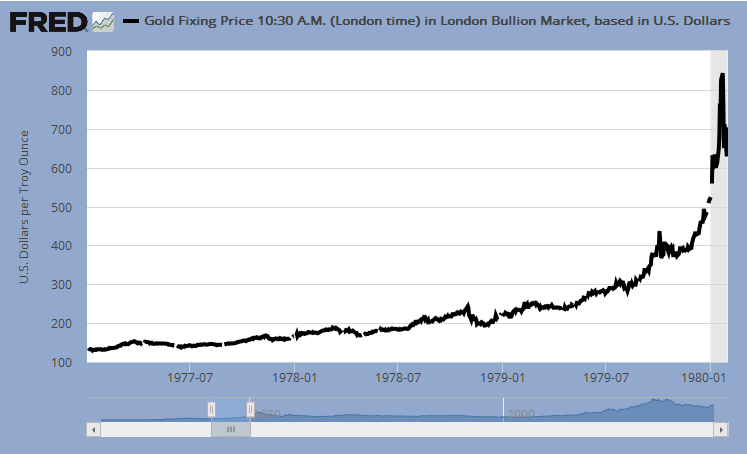
Just after 1:00 am, the sky cleared and stars emerged from behind the storm clouds. There was an eerie calm as someone yelled, “The water level is going down! The flood is retreating!”

There was little chance to enjoy that calm. One survivor recalled that a few minutes later it “sounded like the sky was collapsing and the earth was cracking.” The equivalent of 280,000 Olympic-sized swimming pools burst through the crumbling dam, taking with it entire towns and ultimately hundreds of thousands of lives.

The 24.5-meter dam of Banqiao Reservoir which took the most rain from the typhoon first breached at wee hours of Aug. 8, releasing within six hours 700 million cubic meters of water that wiped Daowencheng down river from the map immediately, killing all 9,600 citizens.

“Houses and trees disappeared all in a instant. Thousands of corpses and cattle floated in water.”

To worsen the situation, the facilities of 62 reservoirs collapsed or were damamged down river one after another unleashing about 6 billion cubic meters of water over an area of 10,000 square kilometers.

Official statistics recorded 30 years latter show more than 10 million people were affected, all communication to and from the cities were cut off for months, some never restored until years latter.

The appalling images of the dams burst were not publicized during at that time. Chinese leaders considered natural disaster death tolls a state secret, an investigation by the central government soon after the floods found a series of “unexpected structural failures” that led to the disaster.

Li Zechun, who first arrived at the scene (now the Chinese Academy of Engineering Sciences) qualified the tragedy “as a man-made calamity rather than a natural one.”

Li said the water storage for irrigation function of a reservoir was overemphasized amid reservoir construction despite warnings by scientists that much of a reservoir’s flood control was inadequate .

The Banqiao Reservoir was designed with a capacity of only 492 million cubic meters but it had to accommodate more than 700 million cubic meters of floods and it has less than half the recommended gates.

The dam collapsed killing approximately 26,000 people from the initial flooding and another 145,000 during subsequent epidemics and famine. 5,960,000 buildings collapsed, 10 million residents were affected. Unofficial estimates of the number of people killed by the disaster have run as high as 230,000.

US Central Bank Policy (Banqiao Banking)

The Fed’s collsal experiment based on hypothetical academic theory and assumptions Led by Alan Greenspan enabled the crisis.

Greenspan apologizes for his decades of failied Fed policy in this short video.

Then the unproven solutions that Bernanke implemented made the crisis multiple times worse and did irreparable damage.

How could Bernanke with his bio and bad calls on the economy ever have be appointed Fed chair as the US faced its debt crisis?

His Bio and calls on the economy

Now Grandma Yellen tells an apathetic US population economic recovery fairy tales while the 45 year old fiat monetary dam holding back unknown trillions in debt and unfunded liabilities is cracking hard, right down the middle.

Beyond repair

Red = Federal debt

Green = Debt service on the national debt

Blue = Debt held by Federal Reserve Banks

Black = Federal government receipts from personal taxes

Grey = Federal government receipts from corporate taxes

Source Federal Reserve

Are we really supposed to believe this fester of Central Bankers (FOMC voting members) made up mostly of Academics with very little private sector actual work experience will lead the US out of its biggest financial crisis in history?

Click here for their career history

Actual pictures

I run a family office from a beautiful tax free Caribean Island, I’ve been a professional trader for over 20 years including time on the floor. My sole professional purpose is the preservation and enhancement of family wealth. I don’t sell a newsletter, I won’t manage a penny of US investor money but I do enjoy trading US markets especially on days like Brexit.

The gains we make on the moves generated by events such as Greece or Brexit would be a whole lot more rewarding if they we’re generated by good news rather than bad and we didn’t have to worry about preservation of the money we make on the back end.

Watching the US and european financial systems in a death spirale, the jeopardy current Central Bank policies is putting our US assets in, the potential of these policies setting off a chain reaction impacting our Global assets is more than disturbing

I should be getting drunk and chasing sea turtles with my beautiful wife but at the beach but nooooo, I’m stuck here in my office, buying metals like I’m going to live in a bunker for the rest of my life. I’m working like a galley salve on collaring up my long positions, defining what short positions I’ll be taking next, and when as the current collection idiots tries to figure out you can’t solve a debt problem by creating an even bigger debt problem.

I know the US is becoming more 420 friendly but it appears to me the FOMC members are abusing 24% cannabis while on the toilet, getting so high that they’re flushing ethics, responsibility and common sense down the toilet and what should have been flushed ends up being their decisions.

From their pictures it looks to me like they just can’t handle those 24% Indicas, maybe they should try some milder 4-6% Sativas? I have yet to develop a taste for cannabis but I may have too after their monetary policies banish me to the bunker so I can kill the boredom while I polish my guns before the big rat hunts so I can feed my family.

America

Please elect leadership that has a backbone and can make responsible decisions. Trump with his temper/business failures and Hilary Clinton who couldn’t even keep an eye on her own husband is the best you can do?

What ever happened to leaders like Franklin Roosevelt not only did he put millions of Americans back to work rebuidling the infrastructure of the United States he delt with Hiltler, Mussolini and Hirohito and they prepared to try and take over the entire world.

Please find a leader like F.D.R. audit the Fed for the first time in its 102 year history, trash the BLS.GOV and replace the BLS.GOv with a totally indemendant agency that will generate actual economis data (what a concept) . Hold those that created this debt mess responsible, taking vile little vermin like Greenspan and blowhard Bernanke off the 100K to 250K dollar an hour “lecture tour” and onto the jail tour.

All the money the “Quantitative Easing” printing press can print up, all the BLS.GOV revision magic they can dream up, all of Grandma’s Yellen’s economic recovery fairy tales can’t repair the US debt damage, its stage 4, the dam has cracked right down the middle, the charter builder and financial hemorrhage are dead on th horizon

If Greece with an economy the size of Orange County California or the UK (3.94% of the global economy) abandoning a sinking EU ship can rattle the markets, just imagine when the fertilizer hits the fan in the US representing 23.32% of the global economy.

Sure it’s going to be a lot of fun to trade the major market moves that will be generated, sure we stand to enhance our fortunes, but I for one would rather make money off of good news than economic misery fueled by surfeit of politicians and intrusion of miscreant Central Bankers.

Quotes for the day

Suppose you were an idiot. And suppose you were a member of Congress. But I repeat myself. – Mark Twain

In my many years I have come to a conclusion that one useless man is a shame, two is a law firm, and three or more is a congress. – John Adams

US Consumer Price Index Fact or BLS.GOV Fiction?

Less than 9% of professional traders surveyed give the current C.P.I. releases credibility. 91% believe the actual C.P.I. is higher, 63% believe the CPI is more than twice reported C.P.I.

What the C.P.I. is used for

Since 1919 the CPI has been used as a benchmark to set US Treasury deposit rates.

Source Federal Reserve

The C.P.I. is also used in Adjusting Income and Payments for Government Expenditures; Social Security beneficiaries, Military, all Government Employee salaries, welfare, food stamp recipients, Governmental rents, nearly everything right down to school lunches.

Since 1978 there has been justifiable controversy about the creditability of the C.P.I. currently B.L.S. creditability is at a new all time low.

Fact or fiction?

Let’s compare current “revised and weighted” BLS.GOV C.P.I. calculations to the constant pre 1980 calculations for;

  • Predicting the price for gold from 1971 to 2015
  • Governmental expenditures 1978 to 2015

Gold

In 1971 the US abandoned the US dollar’s peg to gold, gold was trading at $40.80.

Current BLS.GOV C.P.I. calculations 

According to 618 million dollars in annual BLS.GOV funding the price of gold should have risen from $40.80 in 1971 to $238.77 by 2015.

Use the BLS.GOV inflation calculator on this page enter the data below.

Actual price of gold for 2015, $1,159.82

Current calculations are off by $921.05 per ounce.

Pre 1980 BLS.GOV C.P.I. calculations

The price of gold should have been $1,1104.78 in 2015.

Actual price of gold $1,159.82.

Pre 1980 calculations were off by $55.05 per ounce for the 45 year period.

$55.05 per ounce is slightly greater than the most recent 5 day range for gold of $41 and less than half the most recent 1 month range of $125.


Sources Federal Reserve Williams 1980 Pre revision CPI data

Prior to doing the numbers on Governmental expenditures lets look at the demise of C.P.I. creditability and why.

In 1969 Federal debt service cost began to outpace Federal tax receipts, by 1971 the debt service cost/tax receipt ratio was considered “unmanageable”.

Source Federal Reserve

To resolve this problem in 1971 President Richard Nixon (prior to his impeachment hearings), then Fed chair Arthur Burns along Paul Volcker abandoned the gold standard.

The US dollar officially became a Fiat currency enabling the US’s private Central Bank to create as much money as the US Treasury needed (at their unaudited discretion) to satisfy the Treasury’s debt addiction.

The US had two choices

1) To change course and use the ability to create money to bridge deficit gaps until the causes of the deficits could be discovered and resolved.

2) To maintain its course indulging in short-term monetary gratification with complete disregard of the long-term consequences, dollar valuation, inflation or future generations.

Unfortunately, the US chose option # 2, budget deficits soared and the national debt grew from 391 billion in 1971 to 845 billion by 1979 or +116.11%.

Source Federal Reserve

Predictably, the creation of massive amounts of money backed by no tangible assets or income flow generated U.S. dollar devaluation and double-digit inflation.

Source Federal Reserve

With double-digit inflation interest Treasury rates soared without hesitation.

Source Federal Reserve

U.S. Federal debt service cost and all other Governmental expenditures skyrocketed generating a population adjusted per capita increase in Federal Spending of 156.38% for the 9 year duration of the US’s newly created “fiat currency“.

1971 & 1980 data source USGovernmentspending.com

Even with the minor modifications that had been made to the B.L.S. C.P.I. calculations “to more accurately report inflation” the B.L.S. calculations show an increase of 124%.

Source BLS.GOV

By 1980 the US dollar looked doomed, nearly every tangible asset on the board rallied against the US dollar, speculation frenzied, 100’s of millions were being made and lost in minutes.

Gold and silver moved sharply higher, bullion banks were facing “fails to deliver“. Bankers, the Fed, US Treasury, Bureau of Labor and Statistics, exchanges and Global Investors were in panic mode.

Source Federal Reserve

Solution

36 years ago the US Treasury, BLS.GOV and Fed still had a shred of conscience. Paul Volcker the newly appointed Fed chair began a series of very aggressive rate hikes to contain inflation.

At the same time the B.L.S. was given the “all clear” by their employer (The U.S. Government) to use “revisions” more aggressively “to more accurately report US inflation and employment”.

By 1983 Volcker was hailed as a hero because the cumulative impact of his tight monetary policies and BLS.GOV inflation calculation magic had dropped the reported BLS.GOV inflation from its peak of nearly 15% in 1980 to under 3% by 1983.

This video tells the story in 2 1/2 minutes

The market’s reaction shows the impact

A) 1979 Volcker begins a series of aggressive rate hikes, the yield curve inverts. (short-term rates exceed long-term rates)

B) 1980 higher rates “revised” BLS.GOV inflation calculation magic fully engages, the initial reaction is muted at first as the market just doesn’t believe it.

C) In 1983 after more than a decade of high inflation it magically lowers from near 15.00% to less than 3.00% containing Federal debt service cost and all increases in governmental expenditures that are linked to the “official” CPI such as Social Security.


Source Federal Reserve

What the market didn’t pay attention to in 1980 and still isn’t in 2016 are the major revisions to the way that the C.P.I. is being calculated or the impact of BLS.GOV revision magic to U.S. citizens, U.S. debt holders or the motivation for the revisions.

The Consumer Price Index (C.P.I.) was created to help businesses; individuals and government adjust their financial planning for the impact of inflation.

Let’s do the math and compare BLS.GOV inflation calculations to actual price increases from 1978 to 2015.

Actual Federal Spending per capita for 1978 was $2,093.02

Sector 1978
1 Total Spending $458,746,000,000
2 Total Population 219,179,000
3 Fed Spending Per Capita $2,093.02
4 Pensions $103,617,000,000
5 Health Care $41,292,100,000
6 Education $27,867,000,000
7 Defense $130,939,000,000
8 Welfare $38,292,000,000

Using BLS.GOV inflation calculation methods, posted on the BLS.GOV website, per capita Federal spending should have increased from $2,093.02 in 1978 to $7,068.61 by 2015 or up 273.15%

Actual Federal spending per capita in 2015 was $11,339.23 or up 456.11%, the BLS.GOV again is off this time by 182.96%

Sector 2015
1 Total Spending $3,688,290,000,000
2 Total Population 325,268,000
3 Fed Spending Per Capita $11,339.23
4 Pensions $953,604,000,000
5 Health Care $1,028,425,000,000
6 Education $133,780,000,000
7 Defense $797,878,000,000
8 Welfare $361,872,000,000

This 456.11% increase was contained by the BLS.GOV understating inflation and short-changing 100’s of millions of Savers, Pensioners, US Soldiers, families of fallen Soldiers, Policemen, Firemen, Teachers all other Federal Employees and Governmental suppliers out of trillions of dollars to save their employer the US government the same.

There is no conscience in the Treasury.GOV and BLS.GOV game.

You can take nearly any period on anything from home prices, oil, food, college tuition stocks or funeral costs and the BLS.GOV calculations on this page will underestimate the actual increase by a significant amount.

Facts

BLS.GOV revision magic saved the U.S. Treasury over 1.5 trillion in 2015, just in debt service cost and pensions alone.

Below the last 20 years for debt service cost and pensions (without compounding)

BLS.GOV revision magic has saved their employer the U.S. Treasury on average 1/2 a trillion per year versus the pre 1980 BLS.GOV C.P.I. calculation methods.


Sources Federal Reserve , USGovernmentspending.com Williams 1980 Pre revision CPI data

What per capita Government expenditures would be using pre 1980 BLS.GOV calculation methods.

Per capita Federal spending would be closer to 35K not 11K

Sector 2015
1 Total Spending $11,444,243,457,684
2 Total Tax receipts $3,249,886,000,000
5 Fed Spending Per Capita $35,184.04
4 Total Population 325,268,000
3 Deficit ($8,194,357,457,684)
6 Pensions $953,604,000,000
7 Health Care $1,028,425,000,000
8 Education $133,780,000,000
9 Defense $797,878,000,000
10 Welfare $361,872,000,000

The Way it was prior to 1980

Measurement of consumer inflation traditionally reflected measuring the cost of maintaining a constant standard of living, as measured by a fixed-basket of goods.

The changing costs of maintaining a constant standard of living were measured by pricing out a fixed-basket of goods and services-same components, same weighting-period after period.

Whatever the percentage change was in the cost of that basket of goods that is how much income would have to rise in order for someone to maintain a fixed or constant standard of living over the given period.

Tracking changes in the cost of a fixed basket of goods was the approach to estimating inflation, going back to at least the 1700s. Prior to 1945, the fixed-basket CPI tracked by the U.S. government was known as the Cost of Living Index.

It assumes you
Lived in the same size home
Ate the same food
Used the same amount of Energy
Your children attended the same schools
Had the same medical coverage
Bought the same brand of drugs
You drank the same amount and brand of Alcohol
Ate at the same restaurants
Attended the same type of theatrical productions
Drove the same type of car
You had the same household staff that worked the same hours

You get the idea; it was a fixed basket measuring the cost of a constant standard of living

The way it is now

The CPI now consists of more than 80,000 items in over 200 categories arranged into eight major groups,Hedonic Quality Adjustments are applied then the data is “weighted” to reflect a “more accurate” representation of inflation.

Are you kidding me? I don’t think I’ve purchased 80,000 different items in my entire life.

Current calculations allow substitution of lower-priced and lower-quality goods in the basket (i.e. replacing château Laffite Rothschild with Boones Farm wine you’re still getting a bottle of wine, it does the same thing, so there is no change in price that impacts inflation) It actually can lower the reported rate of inflation versus the fixed-basket measure.

Geometric weighting; a purely a mathematical gimmick that automatically reduces the weighting of goods rising in price, and vice versa, it has no demonstrated relationship to consumer substitution of goods based on price changes. It was explained as a surrogate for a substitution measure.

More frequent re weightings of the CPI index from every ten years to every two years, which moved the CPI closer to a substitution based index, but the change was not considered a change in methodology.

Ongoing re-weightings of sales outlets, also moving closer to a substitution-based index and creating other constant standard of living issues. If you can no longer afford your tailor you can by your clothes at K-mart, you’re still getting a pair of slacks so you’ve helped inflation moved lower.

“Hedonic” quality adjustments, altering the pricing of goods and services for nebulous quality changes that could not be priced directly and that often are not viewed or recognized by the consumer as a desired improvement. (You buy a new boat, it’s the same length and power as your old boat but it costs 50% more, according to the BLS.GOV your new boat is going to last twice as long therefore the price has actually gone down).

It just goes on and on and on, the excuses and justification for revisions are just beyond pathetic. What these revisions are doing to Pensioners, Savers, Federal employees is beyond criminal.

There is only one reason the BLS.GOV “revisions” are in place and 92% of us know it, it’s to save their boss the Treasury.GOV trillions at the expense of US citizens and debt investors.

Sure we’ve all made money on their misrepresentations but I’d rather be reviewing quality long-term positions rather than trying to profit from their next lie.


I run a family office from a tax-free spec of an island 1,770 kilometers south-east of Palm Beach Florida. As the head of a family office my sole professional purpose is the preservation and enhancement of family wealth.