US Consumer Price Index Fact or BLS.GOV Fiction?

Less than 9% of professional traders surveyed give the current C.P.I. releases credibility. 91% believe the actual C.P.I. is higher, 63% believe the CPI is more than twice reported C.P.I.

What the C.P.I. is used for

Since 1919 the CPI has been used as a benchmark to set US Treasury deposit rates.

Source Federal Reserve

The C.P.I. is also used in Adjusting Income and Payments for Government Expenditures; Social Security beneficiaries, Military, all Government Employee salaries, welfare, food stamp recipients, Governmental rents, nearly everything right down to school lunches.

Since 1978 there has been justifiable controversy about the creditability of the C.P.I. currently B.L.S. creditability is at a new all time low.

Fact or fiction?

Let’s compare current “revised and weighted” BLS.GOV C.P.I. calculations to the constant pre 1980 calculations for;

  • Predicting the price for gold from 1971 to 2015
  • Governmental expenditures 1978 to 2015

Gold

In 1971 the US abandoned the US dollar’s peg to gold, gold was trading at $40.80.

Current BLS.GOV C.P.I. calculations 

According to 618 million dollars in annual BLS.GOV funding the price of gold should have risen from $40.80 in 1971 to $238.77 by 2015.

Use the BLS.GOV inflation calculator on this page enter the data below.

Actual price of gold for 2015, $1,159.82

Current calculations are off by $921.05 per ounce.

Pre 1980 BLS.GOV C.P.I. calculations

The price of gold should have been $1,1104.78 in 2015.

Actual price of gold $1,159.82.

Pre 1980 calculations were off by $55.05 per ounce for the 45 year period.

$55.05 per ounce is slightly greater than the most recent 5 day range for gold of $41 and less than half the most recent 1 month range of $125.


Sources Federal Reserve Williams 1980 Pre revision CPI data

Prior to doing the numbers on Governmental expenditures lets look at the demise of C.P.I. creditability and why.

In 1969 Federal debt service cost began to outpace Federal tax receipts, by 1971 the debt service cost/tax receipt ratio was considered “unmanageable”.

Source Federal Reserve

To resolve this problem in 1971 President Richard Nixon (prior to his impeachment hearings), then Fed chair Arthur Burns along Paul Volcker abandoned the gold standard.

The US dollar officially became a Fiat currency enabling the US’s private Central Bank to create as much money as the US Treasury needed (at their unaudited discretion) to satisfy the Treasury’s debt addiction.

The US had two choices

1) To change course and use the ability to create money to bridge deficit gaps until the causes of the deficits could be discovered and resolved.

2) To maintain its course indulging in short-term monetary gratification with complete disregard of the long-term consequences, dollar valuation, inflation or future generations.

Unfortunately, the US chose option # 2, budget deficits soared and the national debt grew from 391 billion in 1971 to 845 billion by 1979 or +116.11%.

Source Federal Reserve

Predictably, the creation of massive amounts of money backed by no tangible assets or income flow generated U.S. dollar devaluation and double-digit inflation.

Source Federal Reserve

With double-digit inflation interest Treasury rates soared without hesitation.

Source Federal Reserve

U.S. Federal debt service cost and all other Governmental expenditures skyrocketed generating a population adjusted per capita increase in Federal Spending of 156.38% for the 9 year duration of the US’s newly created “fiat currency“.

1971 & 1980 data source USGovernmentspending.com

Even with the minor modifications that had been made to the B.L.S. C.P.I. calculations “to more accurately report inflation” the B.L.S. calculations show an increase of 124%.

Source BLS.GOV

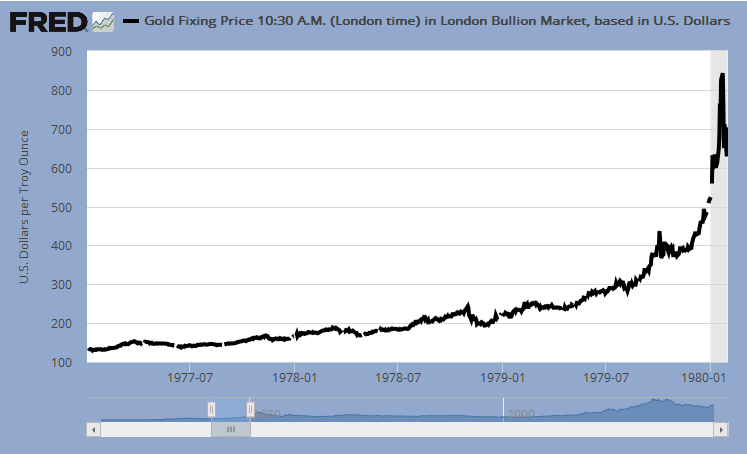
By 1980 the US dollar looked doomed, nearly every tangible asset on the board rallied against the US dollar, speculation frenzied, 100’s of millions were being made and lost in minutes.

Gold and silver moved sharply higher, bullion banks were facing “fails to deliver“. Bankers, the Fed, US Treasury, Bureau of Labor and Statistics, exchanges and Global Investors were in panic mode.

Source Federal Reserve

Solution

36 years ago the US Treasury, BLS.GOV and Fed still had a shred of conscience. Paul Volcker the newly appointed Fed chair began a series of very aggressive rate hikes to contain inflation.

At the same time the B.L.S. was given the “all clear” by their employer (The U.S. Government) to use “revisions” more aggressively “to more accurately report US inflation and employment”.

By 1983 Volcker was hailed as a hero because the cumulative impact of his tight monetary policies and BLS.GOV inflation calculation magic had dropped the reported BLS.GOV inflation from its peak of nearly 15% in 1980 to under 3% by 1983.

This video tells the story in 2 1/2 minutes

The market’s reaction shows the impact

A) 1979 Volcker begins a series of aggressive rate hikes, the yield curve inverts. (short-term rates exceed long-term rates)

B) 1980 higher rates “revised” BLS.GOV inflation calculation magic fully engages, the initial reaction is muted at first as the market just doesn’t believe it.

C) In 1983 after more than a decade of high inflation it magically lowers from near 15.00% to less than 3.00% containing Federal debt service cost and all increases in governmental expenditures that are linked to the “official” CPI such as Social Security.


Source Federal Reserve

What the market didn’t pay attention to in 1980 and still isn’t in 2016 are the major revisions to the way that the C.P.I. is being calculated or the impact of BLS.GOV revision magic to U.S. citizens, U.S. debt holders or the motivation for the revisions.

The Consumer Price Index (C.P.I.) was created to help businesses; individuals and government adjust their financial planning for the impact of inflation.

Let’s do the math and compare BLS.GOV inflation calculations to actual price increases from 1978 to 2015.

Actual Federal Spending per capita for 1978 was $2,093.02

Sector 1978
1 Total Spending $458,746,000,000
2 Total Population 219,179,000
3 Fed Spending Per Capita $2,093.02
4 Pensions $103,617,000,000
5 Health Care $41,292,100,000
6 Education $27,867,000,000
7 Defense $130,939,000,000
8 Welfare $38,292,000,000

Using BLS.GOV inflation calculation methods, posted on the BLS.GOV website, per capita Federal spending should have increased from $2,093.02 in 1978 to $7,068.61 by 2015 or up 273.15%

Actual Federal spending per capita in 2015 was $11,339.23 or up 456.11%, the BLS.GOV again is off this time by 182.96%

Sector 2015
1 Total Spending $3,688,290,000,000
2 Total Population 325,268,000
3 Fed Spending Per Capita $11,339.23
4 Pensions $953,604,000,000
5 Health Care $1,028,425,000,000
6 Education $133,780,000,000
7 Defense $797,878,000,000
8 Welfare $361,872,000,000

This 456.11% increase was contained by the BLS.GOV understating inflation and short-changing 100’s of millions of Savers, Pensioners, US Soldiers, families of fallen Soldiers, Policemen, Firemen, Teachers all other Federal Employees and Governmental suppliers out of trillions of dollars to save their employer the US government the same.

There is no conscience in the Treasury.GOV and BLS.GOV game.

You can take nearly any period on anything from home prices, oil, food, college tuition stocks or funeral costs and the BLS.GOV calculations on this page will underestimate the actual increase by a significant amount.

Facts

BLS.GOV revision magic saved the U.S. Treasury over 1.5 trillion in 2015, just in debt service cost and pensions alone.

Below the last 20 years for debt service cost and pensions (without compounding)

BLS.GOV revision magic has saved their employer the U.S. Treasury on average 1/2 a trillion per year versus the pre 1980 BLS.GOV C.P.I. calculation methods.


Sources Federal Reserve , USGovernmentspending.com Williams 1980 Pre revision CPI data

What per capita Government expenditures would be using pre 1980 BLS.GOV calculation methods.

Per capita Federal spending would be closer to 35K not 11K

Sector 2015
1 Total Spending $11,444,243,457,684
2 Total Tax receipts $3,249,886,000,000
5 Fed Spending Per Capita $35,184.04
4 Total Population 325,268,000
3 Deficit ($8,194,357,457,684)
6 Pensions $953,604,000,000
7 Health Care $1,028,425,000,000
8 Education $133,780,000,000
9 Defense $797,878,000,000
10 Welfare $361,872,000,000

The Way it was prior to 1980

Measurement of consumer inflation traditionally reflected measuring the cost of maintaining a constant standard of living, as measured by a fixed-basket of goods.

The changing costs of maintaining a constant standard of living were measured by pricing out a fixed-basket of goods and services-same components, same weighting-period after period.

Whatever the percentage change was in the cost of that basket of goods that is how much income would have to rise in order for someone to maintain a fixed or constant standard of living over the given period.

Tracking changes in the cost of a fixed basket of goods was the approach to estimating inflation, going back to at least the 1700s. Prior to 1945, the fixed-basket CPI tracked by the U.S. government was known as the Cost of Living Index.

It assumes you
Lived in the same size home
Ate the same food
Used the same amount of Energy
Your children attended the same schools
Had the same medical coverage
Bought the same brand of drugs
You drank the same amount and brand of Alcohol
Ate at the same restaurants
Attended the same type of theatrical productions
Drove the same type of car
You had the same household staff that worked the same hours

You get the idea; it was a fixed basket measuring the cost of a constant standard of living

The way it is now

The CPI now consists of more than 80,000 items in over 200 categories arranged into eight major groups,Hedonic Quality Adjustments are applied then the data is “weighted” to reflect a “more accurate” representation of inflation.

Are you kidding me? I don’t think I’ve purchased 80,000 different items in my entire life.

Current calculations allow substitution of lower-priced and lower-quality goods in the basket (i.e. replacing château Laffite Rothschild with Boones Farm wine you’re still getting a bottle of wine, it does the same thing, so there is no change in price that impacts inflation) It actually can lower the reported rate of inflation versus the fixed-basket measure.

Geometric weighting; a purely a mathematical gimmick that automatically reduces the weighting of goods rising in price, and vice versa, it has no demonstrated relationship to consumer substitution of goods based on price changes. It was explained as a surrogate for a substitution measure.

More frequent re weightings of the CPI index from every ten years to every two years, which moved the CPI closer to a substitution based index, but the change was not considered a change in methodology.

Ongoing re-weightings of sales outlets, also moving closer to a substitution-based index and creating other constant standard of living issues. If you can no longer afford your tailor you can by your clothes at K-mart, you’re still getting a pair of slacks so you’ve helped inflation moved lower.

“Hedonic” quality adjustments, altering the pricing of goods and services for nebulous quality changes that could not be priced directly and that often are not viewed or recognized by the consumer as a desired improvement. (You buy a new boat, it’s the same length and power as your old boat but it costs 50% more, according to the BLS.GOV your new boat is going to last twice as long therefore the price has actually gone down).

It just goes on and on and on, the excuses and justification for revisions are just beyond pathetic. What these revisions are doing to Pensioners, Savers, Federal employees is beyond criminal.

There is only one reason the BLS.GOV “revisions” are in place and 92% of us know it, it’s to save their boss the Treasury.GOV trillions at the expense of US citizens and debt investors.

Sure we’ve all made money on their misrepresentations but I’d rather be reviewing quality long-term positions rather than trying to profit from their next lie.


I run a family office from a tax-free spec of an island 1,770 kilometers south-east of Palm Beach Florida. As the head of a family office my sole professional purpose is the preservation and enhancement of family wealth.

Recession slang: 10 new terms for a new economy

The recession may be technically over but its effects on our life and language are far from it. In fact, some recession words have become so ubiquitous ­– staycation, for one (see below) ­– that they just might be here to, ahem, stay.

Recession language isn’t a new phenomenon. Thanks to the Great Depression we have terms like: Okie, dirt poor, and baloney (to mean ridiculous, not the mystery sandwich meat). Even the term “depression” has been attributed to Herbert Hoover, who is thought to have wanted to avoid using the more common, but more alarming terms “panic” or “crisis” to describe what subsequently became known as the Great Depression.

So, in the spirit of trying to laugh at our collective condition, we’ve compiled a lexicon of our Top 10 favorite words birthed by the recession. Laugh, cry, and submit your favorite new-economy words in the comments below.

Recession slang: 10 new terms for a new economy

10. Funemployment, n. The practice of enjoying one’s unemployment.

The funemployed subscribe to the philosophy that in the face of bleak employment prospects, it’s better to make the most of time off by catching up with old (read: also unemployed) friends or developing low-cost hobbies, ideally during normal business hours to realize the additional benefit of irking ones employed friends.

Sample sentence: As part of my funemployment plan, I’ve joined an Ultimate Frisbee league and am providing foster care to three puppies.

See also: Funderemployed (adj.) taking a job that’s fun because employment that pays well or is in one’s field is unavailable.

9. Insource, v. To do oneself what one previously paid others to do.

Sample sentence: “No, I can’t meet you for brunch this morning. I’m insourcing my laundry these days and have five loads piled up.”

Alternate sample sentence: “I know my nails look like someone took a chainsaw to them, but I insource manicures now.”

Antonym: outsource.

8. Staycation, n. Vacationing at home or near home because traveling further would be prohibitively expensive.

For better or worse, staycation is perhaps the most widely-used and accepted term of the new-economy lexicon.

Sample sentence: “That’s right, if something doesn’t change, we’re going to have to staycation at my in-laws this summer … again.”

7. Intaxication, n. A sense of delight mingled with the perception of instant wealth that one feels upon receiving a tax refund.

Sample sentence: “It seemed like a good idea to charge that pair of Louboutins/small boat/Caribbean vacation to my credit card when I got my tax refund. But when I got my statement a week later, it was clear I was in a haze of intaxication at the time of purchase.”

6. Madoff’d, v. To get ripped off in a particularly offensive fashion.

Sample sentence: “Oh man, that cab driver totally Madoff’d me. I gave him a $20 and he only gave me change for a $10.”

5. Recessionista, n. A consumer who has historically paid big bucks to look like a million bucks and who, unwilling to quit his/her fashion habit in the face of the recession, has found alternative ways to maintain a certain standard of wardrobe.

Such strategies often include shopping at discount and second-hand stores. More prevalent in the media than in everyday conversation.

Sample sentence: “The clerks at Barneys are suffering from withdrawal now that I’m a recessionista and rent my handbags online instead of buying.”

See also: frugalista.

Related: “crisis chic” (adj.)

4. Mancession, n. A recession, such as this most recent one, which hits men harder than women.

Sample sentence: “The extent of this mancession became clear to me when I realized it was all dads in F-250s in the carpool line.”

See also: he-cession.

3. Povo, adj. A two-syllable “abbreviation” for poor, often with a mocking or self-defacing tone that lacks any serious derision or the class implications associated with “poor” or “poverty.”

Derivation: Australian (Aussie) English

Sample sentence (better if said with faux Australian accent): “We’re living sans Internet and cable now that my povo roommate won’t chip in for it anymore. It’s like the 1980s around here.”

2. Permatemp, n. The condition of being permanently employed as a temporary worker.

This could be due to lack of motivation to seek permanent employment, inability to find permanent employment, or the permatemp’s belief that a company will eventually hire him/her for the job s/he is currently doing for lower pay and without benefits.

Sample sentence: “Wake up, Joe. You’ve been here for six months, your cubicle is decorated better than your living room, and the hiring manager still doesn’t know your name. You’re officially a permatemp, my friend.”

1. Decruited, adj. To be fired from a position one has not even started yet.

Sample sentence: “At first I felt really bad about being decruited from that corporate law firm after spending two summers of law school interning for them. But then I decided to make the most of my funemployment and use my signing bonus to travel around Europe.”

The Sad Story Of the Hunt Brothers

HUNT BROTHERS & 1980 SILVER SHORT SQUEEZE

The last major silver short squeeze was in 1980.  During the squeeze, the New York and Chicago exchanges halted silver trading several times.  Whenever markets were disrupted, the price quoted in New York did not match the price buyer had to pay for the actual silver.

Premiums above the spot price for silver got very high – as much as $10 per Troy ounce.  However, people were happy to pay the high premiums, and glad to get silver in almost any form.  Customers were not concerned about brands, shapes, or sizes of silver bars, or denominations of U. S. 90% silver coins.  They just wanted silver.

S T A G F L A T I O N
America was almost in a depression during the 1970s.  Economists called it stagflation.  We had high unemployment and sky-high fuel costs.  And, inflation was terrible.  The U. S. economy was in pretty bad shape; but not in the shambles it is now.

After the U. S. abandoned a gold standard in 1971, people began buying gold and silver coins to protect themselves from the dollar’s loss of purchasing power.  Most coin and bullion buyers weren’t looking for paper dollar profits.  They wanted tangible assets to hedge against a crumbling dollar.

T H E    L A S T   M A J O R    S I L V E R S H O R T    S Q U E E Z E

Silver was $1.95 per ounce in the early 1970s, when Nelson Bunker Hunt, William Herbert Hunt, and other wealthy investors began accumulating physical silver.  They informed the public they would be systematically building physical positions in silver.  Over a period of years, silver moved from $5 to about $11 per ounce mid-1979.  Silver was more than $30 per ounce at the end of 1979.

The Hunt brothers’ long position was 100 million ounces of silver. On each delivery month, the Hunts and other investors paid off their contracts and were taking delivery of the silver (5,000 ounces of silver per contract).  Until then, there never had been so much demand for so much physical silver on the exchanges. *

As silver began moving sharply up in 1979, the bullion banks were facing “fails to deliver” on their open contracts.  It was rumored nine directors of the COMEX held massive short positions in silver.  The situation was called a silver short-squeeze.  At the end of the squeeze, the market was near collapse and the shorts were almost broken.  The short squeeze threatened the very viability of the exchange.  The rules for trading silver on the COMEX (Commodities Exchange New York) and CBOT (Chicago Board of Trade) were changed many times until the squeeze came to an end.

W H E N    T H E    E X C H A N G E S  H A L T E D    S I L V E R    T R A D I N G

The exchanges stopped trading silver several times during the  silver short squeeze (and during its aftermath).  There were “limit up” days, “limit down” days, and “liquidation only” days.  There was uncertainty in the exchanges, tremendous price volatility, and extraordinarily wide spreads (big percentages between bid and ask).  Locking in prices over the phone became risky for customers, wholesalers, and dealers.

In those frantic days, people stood in lines half-way around city blocks at coin shops throughout the country, hoping dealers would not run out of silver.  People even traded with each other while standing in lines.  Supplies of silver bars and silver coins were strained to the breaking point.

C O M E X    S I L V E R :  L I Q U I D A T I O N    O N L Y

Time after time, exchanges such as the COMEX and the CBOT raised margin requirements in an attempt to drive the price of silver down, and make it too expensive for investors to stay “long” in the silver market.

Then, they limited the number of contracts investors could buy.  In New York, customers were limited to 10 million ounces of silver; the CBOT put on a limit of 3 million ounces.  In March 1980, the CFTC (U. S. Commodity Futures Trading Commission) finally broke the back of the silver short squeeze.


Silver was on its way to $50/oz. The final game rule was changed to stop the price advance.  The CFTC banned all purchases of silver contracts, allowing liquidation only.

Silver tumbled 50% in four days.
The total decline was 78% in two months.

After the silver market plummeted, it remained in the tank for more than twenty years.  The shorts made fabulous profits.  And, those on the other side of the trade lost their shirts.  With the price of silver in the $20s, the Hunts were unsuccessful in their efforts to raise capital to pay margin calls.  The Hunts declared private bankruptcy in 1980.  In the end, Hunt liabilities were $2.5 billion and their assets had been reduced to $1.5 billion.


The Hunt brothers were not big enough
to fight the financial insiders bankrolled
by the Federal Reserve; or powerful enough to counter the actions of the CFTC.  

In August 1988, the Hunts were convicted and heavily fined for “conspiring to manipulate the market.”

The Hunt brothers were not the conspirators.  They were the victims of the same short-sellers who manipulate the prices of precious metals to this day.    

Peter Knight

Click here for contact details

x


RISK DISCLOSURE STATEMENT

PROGRAM AVAILABILITY IS DEPENDENT ON YOUR COUNTRY OF RESIDENCY AND FINANCIAL STATUS

PAST RESULTS ARE NOT NECESSARILY INDICATIVE OF FUTURE RESULTS. EXAMPLES OF HISTORIC PRICE MOVES OR EXTREME MARKET CONDITIONS ARE NOT MEANT TO IMPLY THAT SUCH MOVES OR CONDITIONS ARE COMMON OCCURRENCES OR ARE LIKELY TO OCCUR.

HYPOTHETICAL PERFORMANCE RESULTS HAVE MANY INHERENT LIMITATIONS, SOME OF WHICH ARE DESCRIBED BELOW. NO REPRESENTATION IS BEING MADE THAT ANY ACCOUNT WILL OR IS LIKELY TO ACHIEVE PROFITS OR LOSSES SIMILAR TO THOSE SHOWN IN FACT, THERE ARE FREQUENTLY SHARP DIFFERENCES BETWEEN HYPOTHETICAL PERFORMANCE RESULTS AND THE ACTUAL RESULTS SUBSEQUENTLY ACHIEVED BY ANY PARTICULAR TRADING PROGRAM. ONE OF THE LIMITATIONS OF HYPOTHETICAL PERFORMANCE RESULTS IS THAT THEY ARE GENERALLY PREPARED WITH THE BENEFIT OF HINDSIGHT.

IN ADDITION, HYPOTHETICAL TRADING DOES NOT INVOLVE FINANCIAL RISK, AND NO HYPOTHETICAL TRADING RECORD CAN COMPLETELY ACCOUNT FOR THE IMPACT OF FINANCIAL RISK IN ACTUAL TRADING. FOR EXAMPLE, THE ABILITY TO WITHSTAND LOSSES OR TO ADHERE TO A PARTICULAR TRADING PROGRAM IN SPITE OF TRADING LOSSES ARE MATERIAL POINTS WHICH CAN ALSO ADVERSELY AFFECT ACTUAL TRADING RESULTS. THERE ARE NUMEROUS OTHER FACTORS RELATED TO THE MARKETS IN GENERAL OR TO THE IMPLEMENTATION OF ANY SPECIFIC TRADE PROGRAM WHICH CANNOT BE FULLY ACCOUNTED FOR IN THE PREPARATION OF THE HYPOTHETICAL PERFORMANCE RESULTS AND ALL OF WHICH CAN ADVERSELY AFFECT ACTUAL TRADING RESULTS.

BID/ASK SPREADS, BROKERAGE COMMISSION, CLEARING, EXCHANGE AND REGULATORY FEES WILL HAVE AN ADVERSE IMPACT ON THE NET OVERALL PERFORMANCE OF YOUR ACCOUNT. PRIOR TO MAKING A DECISION TO PARTICIPATE IN ANY INVESTMENT MAKE SURE YOU FULLY UNDERSTAND THE FEES ASSOCIATED WITH TRADING.

THE INFORMATION PROVIDED IN THIS REPORT CONTAINS RESEARCH, MARKET COMMENTARY AND TRADE RECOMMENDATIONS. YOU MAY BE SOLICITED FOR AN ACCOUNT BY ONE OF OUR REPRESENTATIVES OR EMPLOYEES. IT SHOULD BE KNOWN THAT THE REPRESENTATIVES OF OUR FIRM MAY TRADE FUTURES AND OPTIONS FOR THEIR OWN ACCOUNTS OR THOSE OF OTHERS. DUE TO VARIOUS FACTORS (SUCH AS MARGIN REQUIREMENTS, RISK FACTORS, TRADING OBJECTIVES, TRADING INSTRUCTIONS, TRADING STRATEGIES, AND OTHER FACTORS) SUCH TRADING MAY RESULT IN THE LIQUIDATION OR INITIATION OF FUTURES OR OPTIONS POSITIONS THAT DIFFER FROM THE OPINIONS AND RECOMMENDATIONS FOUND IN THIS REPORT.

PAST PERFORMANCE IS NOT NECESSARILY INDICATIVE OF FUTURE PERFORMANCE. THE RISK OF LOSS IN TRADING FUTURES CONTRACTS OR COMMODITY OPTIONS CAN BE SUBSTANTIAL, AND THEREFORE INVESTORS SHOULD UNDERSTAND THE RISKS INVOLVED IN TAKING LEVERAGED POSITIONS AND MUST ASSUME RESPONSIBILITY FOR THE RISKS ASSOCIATED WITH SUCH INVESTMENTS AND FOR THEIR RESULTS.

YOU SHOULD CAREFULLY CONSIDER WHETHER SUCH TRADING IS SUITABLE FOR YOU IN LIGHT OF YOUR CIRCUMSTANCES AND FINANCIAL RESOURCES.

Who’s Right the Market or the Fed ?

  • The Market and Fed are telling two different stories on where rates will be, when and the validity of economic recovery.
  • The Fed says 10, 0.25% hikes by December 2018 the US market a maximum of 3, Eurozone 1 and UK  1.
  • Global equity markets now appear to be drawing the same conclusions about “economic recovery” as rates.
  • This report shows how to calculate market expectations for rates to the 0.01% though March 2026.
  • Introduces strategy to define risk on every trade and for the duration of every trading period without wasting money on option time premium to hedge.

Latest Fed guidance

  • Expect 10, 0.25% rate hikes by December 2018
  • “Economic recovery” is underway and will continue  at a moderate pace
  • Interest rates will “normalize” by 2019

Source Federal Reserve

35+ trillion in open position face value tells us

  • Expect a maximum of 3, 0.25% rate hikes by December 2018
  • Rates will not “normalize” this decade
  • True economic recovery will take far longer than than the most pessimistic of Fed guesstimates.

A-C on the chart below shows the markets expectations for rate hikes

A) In January 2013 the market was pricing in  6 , 0.25% rate hikes by December 2018, with the spread between the June 2016 (GEM16) and December 2018 (GEZ18) deliveries at 1.50, position value 3,750.00 USD

B) By November 2013, optimism for US economic recovery and rate normalization peaked with the market pricing in 10, 0.25% rate hikes with the spread at 2.50, position value 6,750.00 USD

C) Current rate hike expectations have dropped to less than 3, 0.25% hikes,   with the spread at 0.6250, position value 1,562.50 USD

D) If the market had faith in the  Fed’s projections  the spread between the June 2016 (GEM16) and December 2018 (GEZ18) deliveries would be 2.50 reflecting the Fed’s expected 10, 0.25% hikes, position value 6,250 USD.

Screenshot_2
Current chart

How to calculate the market’s expectations to 0.01% through March 2026

Use the quotes on this Exchange page

To convert the contact delivery price into rate it represents take 100.00 – contract price = the rate.

Example, 100.00 – the December 2016 contract price of 99.17 = an expected rate of 0.83%.

To calculate expected rate increases between delivery months take the nearby delivery  minus the forward delivery equals the expected rate change between the delivery months.

Example, June 2016 delivery trading at 99.3350 – December 2016 at 99.1700 = the expected increase in rates from  June 2016 to December 2016 = 0.1650%.

Screenshot_46

What U.S. price action tell us.

  • The market’s perception of economic recovery is far worse than the Fed’s.
  • Rates will not “normalize” during this decade.
  • Fed and US fiscal policy makers creditability with the market is at a low

Eurozone market expectations are worse. 

A) In January 2013 the Eurozone  expected an increase in the 3 month Euro Interbank Offered Rate (EuriBor) between June 2016 (IMM16) and December 2018 (IMZ18) of 0.6000%, position value 1,500.00 EUR

B) By November 2013 optimism for Eurozone economic recovery and rate normalization peaked with an expected increase in the EuriBor rate between June 2016 (IMM16) and December 2018 (IMZ18) of 1.10%, position value 2,750.00 EUR

C) Currently optimism for Eurozone economic recovery and rate normalization has hit a low with an expected increase in the EuriBor rate between June 2016 (IMM16) and December 2018 (IMZ18) at 0.10%, position value 250 EUR.

Screenshot_6
Current chart

Converting the contact price into rate increase/decrease and between delivery months works the same as the US.

Use the quotes on this Exchange page  to calculate today’s Eurozone rate expectations through March 2022

Screenshot_23

3 Month EuriBor price action tells us

  • The EuriBor rate is expected to move 0.0350% lower during 2016
  • The market sees only a 0.0700% rate increase between now and December 2018
  • The EuriBor rate will remain negative through December 2019
  • Eurozone rates will not “normalize” this decade

United Kingdom, nearly the same

A) In January 2013 the UK market action expected an increase in UK 3 month rates between June 2016 (LZ16)  and December 2018 (LZ18) of 1.20%, position value 3,000.00 GBP.

B) By January 2014 optimism peaked with the market  at 1.60%, position value 4,125.00 GBP.

C) Currently  UK market action says a 0.30% increase, position value 750.00 GBP.

Using the quotes on this exchange page conversions and expected increase/decrease work the same as the U.S. and Eurozone.

Screenshot_8

What the Global Stock markets telling us about “economic recovery”

Let’s skip all the subjective fundamental economic over analysis and look at the big picture  price action. Price action is telling us uncertainty and doubt about economic recovery has now spread into the global equity markets.

S&P 500 traded at the CME

On the 16 year S&P chart below note the current volatility relative to the overall rate of change, The monthly moving average (green) has been violated, the majority of the price action is now below the moving average.

Does this market look like it’s in a healthy up trend to you?

Screenshot_15
Analysis Page

DAX traded at EUREX 

Increased volatility relative to the overall rate of change, the DAX has broken below the monthly moving average (green), the majority of the price action is now below the moving average and the long term trend appears to be changing from up to down.

Screenshot_18
Analysis Page

Nikkei 225 traded at  JPX

Increased volatility, the market has broken below the monthly moving average (green), the majority of price action now remains below the moving average, the long term trend appears to be shifting from up to down.

Screenshot_20Analysis Page

Survival

  • Put opinions aside, trade with the trend, long or short
  • Learn new markets and strategies.
  • Trade whatever market/sector has the highest return on risk
  • Define your risk on your trades and for the duration of the trading period without wasting precious investment capital on option time premium to hedge risk.

One example of defined risk trade using the Euro Stoxx 50 traded at EUREX

Looking at the chart below is it really that hard to identify the current daily trend using the moving average (green) ? We’ve seen the break  below the daily moving average with the majority of current price action now below the average.

Screenshot_7
Analysis Page

On the weekly, break below the moving average (green) the majority of the price action now below the average.

Screenshot_17
Monthly,  break below the average (green) with the majority of the price action below the average.

Screenshot_71
Analysis Page

The daily, weekly and monthly charts tell to short

Let’s check this conclusion against some common technical indicators

Screenshot_48
Analysis Page

Eurozone rate expectations sum up the economic fundamentals.  The EuriBor is pricing in lower rates during 2016 moving from the current negative 0.2550% to negative 0.2900% by December 2016. EuriBor traders are telling us loud and clear true economic recovery isn’t expected for the Eurozone in 2016.

Structuring a defined risk trade shorting the Euro Stoxx 50

A) Short the Euro Stoxx 50 at 3,000, position value 30,000 EUR
B) Write the 2,800 put collecting premium
C) Using the collected premium purchase the 3,200 call to hedge the short position

Screenshot_70
Exchange quotes

Trade Summary

  • Risk is defined on the trade and for the duration of the trading period
  • This trade cannot be stopped out regardless of market volatility, the only thing needed to be profitable is anticipating the market’s overall direction correctly.
  • The trade can be liquidated at any time ,  you do not need to hold the position to expiration.
  • The only way the 3,000 short can be pulled away is at a 2,800 generating a gross profit of 2,000 EUR.
  • If the market reverses and rallies to 3,800 losses above 3,200 are hedged by the 3,200 call with losses limited to 2,000 EUR.
  • If the market stays the same and you’ve structured your trade correctly you should break even as  you’ve collected as much time premium on the 2,800 put write against your 3,000 short as you’ve paid out for the 3,200 call  to hedge.

Effective “option collar” strategies are not limited to the international futures markets they can be employed in any market that has underlying option liquidity.

Examples

Baxter International Inc (BAX) – NYSE, Bank of America Corporation (BAC) – NYSE, General Electric Company (GE) – NYSE, SPDR S&P 500 Trust ETF (SPY) – NYSEARCA, iShares MSCI Emerging Markets ETF (EEM) – NYSEARCA, SPDR S&P Metals and Mining ETF (XME) – NYSEARCA, Pfizer Inc. (PFE) – NYSE, Apple Inc. (AAPL) – NASDAQ, SPDR Gold Trust ETF (GLD) – NYSEARCA, iPath S&P 500 VIX Short-Term Futures ETN (VXX) – NYSEARCA, Market Vectors Gold Miners ETF (GDX) – NYSEARCA, Ford Motor Company (F) – NYSE, Financial Select Sector SPDR ETF (XLF) – NYSEARCA, iShares China Large-Cap ETF (FXI) – NYSEARCA, Shares Russell 2000 ETF (IWM) – NYSEARCA,

Let’s take a look how a “collared” position protected me in Apple AAPL

I’m sure I wasn’t the only one caught long Apple AAPL  at 130 USD in July 2015

I made the mistake of getting too attached to being long this stock from 75.00 USD and stayed long in July 2015 at 130.00 USD despite the daily trend telling me it was questionable.

Screenshot_56

The weekly trend was telling me I was wrong

Screenshot_58
The monthly still appeared up with only a few “bumps” against the moving average and no sustained price action below the average.

Screenshot_59

The technical indicators continued to deteriorate

Screenshot_69

Rather than reverse to short or liquidate my Apple position I maintained my long hedging it up with a collar shown A-C on the chart below.

A) At the time I put down the collar AAPL was at 129.62 USD
B) I wrote the 140.00 1 month call against my long
C) Using the collected premium I purchased the 120.00 put

Screenshot_61
Price action got ugly quick and the market broke hard eventually taking out 110.00 USD which was disappointing but tolerable as I had my 120.00 put hedge in place negating any losses below 120.00.

I delivered my longs at 120.00, had I not “collared” this position it could have been far worse, AAPL eventually violated 95.00 USD  on that run lower and has not seen a sustained move above 120.00 since.

Screenshot_62

This Apple trade was yet another refresher course for me not getting too “attached” to a stock,  to pay attention to price action and not fight market momentum.

If you’re attached to your long shares or index positions (as I was too apple)  you too might want to take a good hard look at the current price action and start “collaring up” positions to prevent a financial character builder.

I don’t think anyone knows for sure where the peak will be for the S&P 500 and Global equity markets.

Screenshot_85

What we do know for sure is when the S&P 500 and Global equities break the financial  impact can be worse than a divorce and five kids in private school.

Screenshot_84

Using “collars” to control risk on my short to intermediate directional trades has cut my stress level on these trades by 70%. 

 Additional information

3 month rates or Eurodollar deposits are time deposits denominated in U.S. dollars at banks outside the United States. (There is no connection with the euro currency ). The term was originally coined for U.S. dollars deposited in European banks, but it’s expanded over the years to its present definition-a U.S. dollar-denominated deposit in any non US bank for example Tokyo or Beijing would be deemed a Eurodollar deposit. Futures open interest (contracts outstanding exceeds 10 trillion,

Euribor is short for Euro Interbank Offered Rate. The Euribor rates are based on the average interest rates at which a large panel of European banks borrow funds from one another. The Euribor rate is considered to be the most important reference rates in the European money market. The interest rates do provide the basis for the price and interest rates of all kinds of financial products like interest rate swaps, interest rate futures, saving accounts and mortgages.

Short Sterling prices are based on the British Bankers Association London Interbank Offered Rate (LIBOR) for three month sterling deposits in units of 500,000.00 GBP. 3-Month Sterling Futures are traded on the London International Financial Futures and Options Exchange, part of NYSE Euronext. Each contract is for Interest rate on three month deposit of £500,000 of 3-month Sterling.

The Standard & Poor’s 500, often abbreviated as the S&P 500, or just “the S&P”, is an American stock market index based on the market capitalizations of 500 large companies having common stock listed on the NYSE or NASDAQ. The S&P 500 index components and their weightings are determined by S&P Dow Jones Indices. It differs from other U.S. stock market indices, such as the Dow Jones Industrial Average or the Nasdaq Composite index, because of its diverse constituency and weighting methodology. The “Composite Index”,as the S&P 500 was first called when it introduced its first stock index in 1923, began tracking a small number of stocks. 3 years later in 1926, the Composite Index expanded to 90 stocks and then in 1957 it expanded to its current 500. S&P 500 futures trading began in 1988, e-mini contract 1997.

The DAX (Deutscher Aktienindex (German stock index)) is a blue chip stock market index consisting of the 30 major German companies trading on the Frankfurt Stock Exchange. Prices are taken from the Xetra trading venue. According to Deutsche Börse, the operator of Xetra, DAX measures the performance of the Prime Standard’s 30 largest German companies in terms of order book volume and market capitalization It is the equivalent of the FT 30 and the Dow Jones Industrial Average.

The Nikkei 225, the Nikkei Stock Average is a stock market index for the Tokyo Stock Exchange (TSE). It has been calculated daily by the Nihon Keizai Shimbun (Nikkei) newspaper since 1950. It is a price-weighted index (the unit is yen), and the components are reviewed once a year. Currently, the Nikkei is the most widely quoted average of Japanese equities, similar to the Dow Jones Industrial Average. The Nikkei 225 Futures, introduced at Singapore Exchange (SGX) in 1986, the Osaka Securities Exchange (OSE) in 1988, Chicago Mercantile Exchange (CME) in 1990, is now an internationally recognized futures index.

The EURO STOXX 50 is a stock index future of Eurozone stocks designed by STOXX, an index provider owned by Deutsche Börse Group and SIX Group. Its goal is “to provide a blue-chip representation of Supersector leaders in the Eurozone”. It is made up of fifty of the largest and most liquid stocks. The index futures and options on the EURO STOXX 50, traded on Eurex, are among the most liquid futures contracts in the world

Member Firms

ABN AMRO Clearing USA LLC*
ADM Investor Services, Inc.*
Advantage Futures LLC*
AMP Global Clearing LLC*
 ASL Capital Markets Inc.
Banco Bilbao Vizcaya Argentaria, S.A.
Bank of Montreal
Barclays Capital Inc.*
BMO Capital Markets Corp.
BNP Paribas
BNP Paribas Securities Corp.*
BofA Securities, Inc.*
BP Energy Company
BP Products North America Inc.
Bunge Chicago, LLC
Cantor Fitzgerald & Co.*
CHS Hedging, LLC*
CIBC World Markets Corp. +
Citadel Securities LLC
Citigroup Global Markets Inc.*
Clear Street LLC*
Credit Agricole Corporate and Investment Bank
Curvature Securities LLC*
Daiwa Capital Markets America Inc.*
Deutsche Bank AG
Deutsche Bank Securities Inc.*
Direct Access USA LLC*
Dorman Trading, L.L.C.*
DRW Execution Services, LLC
Eagle Market Makers, Inc.
G.H. Financials, LLC*
Gelber Group, LLC
Goldman Sachs & Co. LLC*
Hidden Road Partners CIV US LLC*
HSBC Securities (USA) Inc.*
Ironbeam, Inc.*
Jump Trading Futures, LLC
J.P. Morgan Securities LLC*
Logista Clearing Corporation LLC +
Macquarie Futures USA LLC*
Marex Capital Markets Inc.*
MFI Funding LLC
Mizuho Securities USA LLC*
Montec Securities LLC
Morgan Stanley & Co. LLC*
Nanhua USA LLC*
NatWest Markets Plc
NatWest Markets Securities Inc.*
Nomura Securities International, Inc.*
Optiver Clearing LLC
Palafox Trading LLC
Phillip Capital Inc.*
Plus500US Financial Services, LLC*
Proxima Clearing, LLC
Quantedge Clearing (Chicago), LLC
Rabo Securities USA Inc.
RBC Capital Markets, LLC*
R.J. O’Brien & Associates, LLC*
Royal Bank of Canada
Santander US Capital Markets LLC*
Scotia Capital (USA) Inc.*
SG Americas Securities LLC*
Skylar Clearing LLC
Societe Generale
Standard Chartered Bank
StoneX Financial Inc.*
Straits Financial LLC*
Term Commodities Inc.
The Bank of Nova Scotia
The Toronto-Dominion Bank
TradeStation Securities, Inc.*
UBS Securities LLC*
Wedbush Securities, Inc.*
Wells Fargo Securities, LLC*

If you have questions contact me. 

Peter Knight
Voice & Video Chats.
Message me


Disclosure

Option Write Spreadsheets

1) Option Income Put Write Entry Spreadsheet
2) AUD Option Write Put Entry Spreadsheet
3) 1256 Option Income Put Write Entry Spreadsheet


Screenshot_6

4) Option Income Call Write Exit Spreadsheet
5) AUD Option Write Call Exit Spreadsheet
6)
1256 Option Income Call Write Exit Spreadsheet

Screenshot_5

RISK DISCLOSURE STATEMENT

PROGRAM AVAILABILITY IS DEPENDENT ON YOUR COUNTRY OF RESIDENCY AND FINANCIAL STATUS

PAST RESULTS ARE NOT NECESSARILY INDICATIVE OF FUTURE RESULTS. EXAMPLES OF HISTORIC PRICE MOVES OR EXTREME MARKET CONDITIONS ARE NOT MEANT TO IMPLY THAT SUCH MOVES OR CONDITIONS ARE COMMON OCCURRENCES OR ARE LIKELY TO OCCUR.

HYPOTHETICAL PERFORMANCE RESULTS HAVE MANY INHERENT LIMITATIONS, SOME OF WHICH ARE DESCRIBED BELOW. NO REPRESENTATION IS BEING MADE THAT ANY ACCOUNT WILL OR IS LIKELY TO ACHIEVE PROFITS OR LOSSES SIMILAR TO THOSE SHOWN IN FACT, THERE ARE FREQUENTLY SHARP DIFFERENCES BETWEEN HYPOTHETICAL PERFORMANCE RESULTS AND THE ACTUAL RESULTS SUBSEQUENTLY ACHIEVED BY ANY PARTICULAR TRADING PROGRAM. ONE OF THE LIMITATIONS OF HYPOTHETICAL PERFORMANCE RESULTS IS THAT THEY ARE GENERALLY PREPARED WITH THE BENEFIT OF HINDSIGHT.

IN ADDITION, HYPOTHETICAL TRADING DOES NOT INVOLVE FINANCIAL RISK, AND NO HYPOTHETICAL TRADING RECORD CAN COMPLETELY ACCOUNT FOR THE IMPACT OF FINANCIAL RISK IN ACTUAL TRADING. FOR EXAMPLE, THE ABILITY TO WITHSTAND LOSSES OR TO ADHERE TO A PARTICULAR TRADING PROGRAM IN SPITE OF TRADING LOSSES ARE MATERIAL POINTS WHICH CAN ALSO ADVERSELY AFFECT ACTUAL TRADING RESULTS. THERE ARE NUMEROUS OTHER FACTORS RELATED TO THE MARKETS IN GENERAL OR TO THE IMPLEMENTATION OF ANY SPECIFIC TRADE PROGRAM WHICH CANNOT BE FULLY ACCOUNTED FOR IN THE PREPARATION OF THE HYPOTHETICAL PERFORMANCE RESULTS AND ALL OF WHICH CAN ADVERSELY AFFECT ACTUAL TRADING RESULTS.

BID/ASK SPREADS, BROKERAGE COMMISSION, CLEARING, EXCHANGE AND REGULATORY FEES WILL HAVE AN ADVERSE IMPACT ON THE NET OVERALL PERFORMANCE OF YOUR ACCOUNT. PRIOR TO MAKING A DECISION TO PARTICIPATE IN ANY INVESTMENT MAKE SURE YOU FULLY UNDERSTAND THE FEES ASSOCIATED WITH TRADING.

THE INFORMATION PROVIDED IN THIS REPORT CONTAINS RESEARCH, MARKET COMMENTARY AND TRADE RECOMMENDATIONS. YOU MAY BE SOLICITED FOR AN ACCOUNT BY ONE OF OUR REPRESENTATIVES OR EMPLOYEES. IT SHOULD BE KNOWN THAT THE REPRESENTATIVES OF OUR FIRM MAY TRADE FUTURES AND OPTIONS FOR THEIR OWN ACCOUNTS OR THOSE OF OTHERS. DUE TO VARIOUS FACTORS (SUCH AS MARGIN REQUIREMENTS, RISK FACTORS, TRADING OBJECTIVES, TRADING INSTRUCTIONS, TRADING STRATEGIES, AND OTHER FACTORS) SUCH TRADING MAY RESULT IN THE LIQUIDATION OR INITIATION OF FUTURES OR OPTIONS POSITIONS THAT DIFFER FROM THE OPINIONS AND RECOMMENDATIONS FOUND IN THIS REPORT.

PAST PERFORMANCE IS NOT NECESSARILY INDICATIVE OF FUTURE PERFORMANCE. THE RISK OF LOSS IN TRADING FUTURES CONTRACTS OR COMMODITY OPTIONS CAN BE SUBSTANTIAL, AND THEREFORE INVESTORS SHOULD UNDERSTAND THE RISKS INVOLVED IN TAKING LEVERAGED POSITIONS AND MUST ASSUME RESPONSIBILITY FOR THE RISKS ASSOCIATED WITH SUCH INVESTMENTS AND FOR THEIR RESULTS.

YOU SHOULD CAREFULLY CONSIDER WHETHER SUCH TRADING IS SUITABLE FOR YOU IN LIGHT OF YOUR CIRCUMSTANCES AND FINANCIAL RESOURCES.


Exchange Links

 Section 1

CME Group US JSE South Africa SHFE China
NASDAQ OMX US ASX Australia Zhengzhou China
TMX Canada JPX Japan NSE India
Intercontinental UK US Simex Singapore Moscow Exchange
Eurex Germany HKEX Hong Kong DME Dubai
BM&F Bovespa Brazil DCE China DCCC Dubai

Market Links

  Section 2

US Indices Global Indices Nikkei 225 Mini
E-Mini S&P 500 Euro Stoxx 50 SGX Kikkei 225
E-Mini Nasdaq 100 FTSE 100 Nikkei 225
DJIA mini-sized DAX Index Nikkei 225 Yen
Russell 2000 Mini Swiss Market Index SGX FTSE China A50
E-Mini S&P Midcap CAC 40 S&P TSX 60
CBOE S&P 500 VIX BEL 20 Swiss Market Index
S&P GSCI PSI 20 All Major World Indices

  Section 3

Energies Energies Europe Financials US
Crude Oil WTI Crude Oil Brent T-Bond
ULSD NY Harbor Crude Oil WTI ICE Ultra T-Bond
Gasoline RBOB ICE Gas Oil LS 10-Year T-Note
Natural Gas ICE Natural Gas 5-Year T-Note
Crude Oil Brent (F) ICE RBOB Blendstock 2-Year T-Note
Ethanol Futures ICE Heating Oil 30-Day Fed Funds

  Section 4

Financials Europe 10-Year Long Gilt 3-Month EuriBor
Eurodollar Euro Schatz 10-Year Long Gilt
Euro Bund Euro Buxl 3-Month EuriBor
Euro Bobl Euro OAT Long-Term 3-Month Sterling
10-Year Long Gilt Euro BTP Long-Term 3-Month Euroswiss

 Section 5

Currency Futures Major Cross Rates All Cross Rates
U.S. Dollar Index Swiss Franc New Zealand Dollar
British Pound Euro FX South African Rand
Canadian Dollar Australian Dollar Brazilian Real
Japanese Yen Mexican Peso Indian Rupee DGCX

Section 6

Gold Platinum Palladium
Silver High Grade Copper Metals

Analysis

Calendar   Review links

Section 1

USD EUR GBP CAD JPY CHF
Past 24 News News News News News News
Daily DX-1 E6-1 B6-1 D6-1 J6-1 S6-1
Weekly DX-2 E6-2 B6-2 D6-2 J6-2 S6-2
Monthly DX-3 E6-3 B6-3 D6-3 J6-3 S6-3
Opinion DX-4 E6-4 B6-4 D6-4 J6-4 S6-4
Quotes DX-5 E6-5 B6-5 D6-5 J6-5 S6-5
Options DX-6 E6-6 B6-6 D6-6 J6-6 S6-6
Ranges DX-7 E6-7 B6-7 D6-7 J6-7 S6-7
Technical DX-8 E6-8 B6-8 D-8 J6-8 S6-8
Contract
DX-9 E6-9 B6-9 D-9 J6-9 S6-9

Section 2

AUD NZD MXN BRL RUB CNY
Past 24 News News News News News News
Daily A6-1 N6-1 M6-1 L6-1 R6-1 CNY-1
Weekly A6-2 N6-2 M6-2 L6-2 R6-2 CNY-2
Monthly A6-3 N6-3 M6-3 L6-3 R6-3 CNY-3
Opinion A6-4 N6-4 M6-4 L6-4 R6-4 CNY-4
Quotes A6-5 N6-5 M6-5 L6-5 R6-5 CNY-5
Options A6-6 N6-6 M6-6 L6-6 R6-6 Futures
Ranges A6-7 N6-7 M6-7 L6-7 R6-7 CNY-7
Technical A6-8 N6-8 M6-8 L6-8 R6-8 CNY-8
Contract A6-9 N6-9 M6-9 L6-9 R6-9 CNY-9

Section 3

SP 500 Dow NASDAQ 100 FTSE 100 Euro Stoxx 50 Nikkei               225
Past 24 News News News News News News
Daily ES-1 YM-1 NQ-1 XM-1 FX-1 NO-1
Weekly ES-2 YM-2 NQ-2 XM-2 FX-2 NO-2
Monthly ES-3 YM-3 NQ-3 XM-3 FX-3 NO-2
Opinion ES-4 YM-4 NQ-4 XM-4 FX-4 NO-4
Quotes ES-5 YM-5 NQ-5 XM-5 FX-5 NO-5
Options ES-7 YM-6 NQ-6 XM-6 FX-6 NO-6
Ranges ES-6 YM-7 NQ-7 XM-7 FX-7 NO-7
Technical ES-8 YM-8 NQ-8 XM-8 FX-8 NO-8
Contract ES-9 YM-9 NQ-9 XM-9 FX-9 NO-9

Section 4

Oil WTI Oil Brent Heating Oil Gasoline RBOB Gold Silver
Past 24 News News News News News News
Daily CL-1 QA-1 HO-1 RB-1 GC-1 SI-1
Weekly CL-2 QA-2 HO-1 RB-2 GC-2 SI-2
Monthly CL-3 QA-3 HO-3 RB-3 GC-3 SI-3
Opinion CL-4 QA-4 HO-4 RB-4 GC-4 SI-4
Quotes CL-5 QA-5 HO-5 RB-5 GC-5 SI-5
Options CL-6 QA-6 HO-6 RB-6 GC-6 SI-6
Ranges CL-7 QA-7 HO-7 RB-7 GC-7 SI-7
Technical CL-8 QA-8 HO-8 RB-8 GC-8 SI-8
Contract CL-9 QA-9 HO-9 RB-9 GC-9 SI-9

Section 5

US 3 Month US 1 M Fed Funds US 5 Year Treasury EuriBor 3 Month Euro Bund Sterling 3 Month
Past 24 News News News News News News
Daily GE-1 ZQ-1 ZF-1 IM-1 GG-1 L-1
Weekly GE-2 ZQ-2 ZF-2 IM-2 GG-2 L-2
Monthly GE-3 ZQ-3 ZF-3 IM-3 GG-3 L-3
Opinion GE-4 ZQ-4 ZF-4 IM-4 GG-4 L-4
Quotes GE-5 ZQ-5 ZF-5 IM-5 GG-5 L-5
Options GE-6 ZQ-6 ZF-6 IM-6 GG-6 L-6
Ranges GE-7 ZQ-7 ZF-7 IM-7 GG-7 L-7
Technical GE-8 ZQ-8 ZF-8 IM-8 GG-8 L-8
Contract GE-9 ZQ-9 ZF-9 IM-9 GG-9 L-9

Section 6

Spreads US 3M U16-H19 US 3M Euribor 3M UK 3M US 3M EuriBor U16 H19 UK 3M U16-U19

GEZ16 GEZ18


Stoxx-S&P Dow-Dax AUD-NZD CAD-AUD EUR-CHF Plat-Gold Brent WTI

If  you have any questions or need additional information  contact me

x

____________________________________________________________________________

RISK DISCLOSURE STATEMENT

PROGRAM AVAILABILITY IS DEPENDENT ON YOUR COUNTRY OF RESIDENCY AND FINANCIAL STATUS

PAST PERFORMANCE IS NOT NECESSARILY INDICATIVE OF FUTURE PERFORMANCE. THE RISK OF LOSS IN TRADING FOREX OR FUTURES CONTRACTS OR OPTIONS CAN BE SUBSTANTIAL, AND THEREFORE INVESTORS SHOULD UNDERSTAND THE RISKS INVOLVED IN TAKING LEVERAGED POSITIONS AND MUST ASSUME RESPONSIBILITY FOR THE RISKS ASSOCIATED WITH SUCH INVESTMENTS AND FOR THEIR RESULTS.

BID/ASK SPREADS, BROKERAGE COMMISSION, CLEARING, EXCHANGE AND REGULATORY FEES WILL HAVE AN ADVERSE IMPACT ON THE NET OVERALL PERFORMANCE OF YOUR ACCOUNT. PRIOR TO MAKING A DECISION TO PARTICIPATE IN ANY INVESTMENT MAKE SURE YOU FULLY UNDERSTAND THE FEES ASSOCIATED WITH TRADING.

EXAMPLES OF HISTORIC PRICE MOVES OR EXTREME MARKET CONDITIONS ARE NOT MEANT TO IMPLY THAT SUCH MOVES OR CONDITIONS ARE COMMON OCCURRENCES OR ARE LIKELY TO OCCUR.

HYPOTHETICAL PERFORMANCE RESULTS HAVE MANY INHERENT LIMITATIONS, SOME OF WHICH ARE DESCRIBED BELOW. NO REPRESENTATION IS BEING MADE THAT ANY ACCOUNT WILL OR IS LIKELY TO ACHIEVE PROFITS OR LOSSES SIMILAR TO THOSE SHOWN IN FACT, THERE ARE FREQUENTLY SHARP DIFFERENCES BETWEEN HYPOTHETICAL PERFORMANCE RESULTS AND THE ACTUAL RESULTS SUBSEQUENTLY ACHIEVED BY ANY PARTICULAR TRADING PROGRAM. ONE OF THE LIMITATIONS OF HYPOTHETICAL PERFORMANCE RESULTS IS THAT THEY ARE GENERALLY PREPARED WITH THE BENEFIT OF HINDSIGHT.

IN ADDITION, HYPOTHETICAL TRADING DOES NOT INVOLVE FINANCIAL RISK, AND NO HYPOTHETICAL TRADING RECORD CAN COMPLETELY ACCOUNT FOR THE IMPACT OF FINANCIAL RISK IN ACTUAL TRADING. FOR EXAMPLE, THE ABILITY TO WITHSTAND LOSSES OR TO ADHERE TO A PARTICULAR TRADING PROGRAM IN SPITE OF TRADING LOSSES ARE MATERIAL POINTS WHICH CAN ALSO ADVERSELY AFFECT ACTUAL TRADING RESULTS. THERE ARE NUMEROUS OTHER FACTORS RELATED TO THE MARKETS IN GENERAL OR TO THE IMPLEMENTATION OF ANY SPECIFIC TRADE PROGRAM WHICH CANNOT BE FULLY ACCOUNTED FOR IN THE PREPARATION OF THE HYPOTHETICAL PERFORMANCE RESULTS AND ALL OF WHICH CAN ADVERSELY AFFECT ACTUAL TRADING RESULTS.

YOU SHOULD CAREFULLY CONSIDER WHETHER SUCH TRADING IS SUITABLE FOR YOU IN LIGHT OF YOUR CIRCUMSTANCES AND FINANCIAL RESOURCES.

THE INFORMATION PROVIDED IN THIS REPORT CONTAINS RESEARCH, MARKET COMMENTARY AND TRADE RECOMMENDATIONS. YOU MAY BE SOLICITED FOR AN ACCOUNT BY ONE OF OUR REPRESENTATIVES OR EMPLOYEES. IT SHOULD BE KNOWN THAT THE REPRESENTATIVES OF OUR FIRM MAY TRADE FUTURES AND OPTIONS FOR THEIR OWN ACCOUNTS OR THOSE OF OTHERS. DUE TO VARIOUS FACTORS (SUCH AS MARGIN REQUIREMENTS, RISK FACTORS, TRADING OBJECTIVES, TRADING INSTRUCTIONS, TRADING STRATEGIES, AND OTHER FACTORS) SUCH TRADING MAY RESULT IN THE LIQUIDATION OR INITIATION OF FUTURES OR OPTIONS POSITIONS THAT DIFFER FROM THE OPINIONS AND RECOMMENDATIONS FOUND IN THIS REPORT.


A-2

USD EUR GBP CAD JPY CHF
 Media News  News News   News  News  News
Daily DX-1 E6-1 B6-1 D6-1 J6-1 S6-1
Weekly DX-2 E6-2 B6-2 D6-2 J6-2 S6-2
Monthly DX-3 E6-3 B6-3 D6-3 J6-3 S6-3
Opinion DX-4 E6-4 B6-4 D6-4 J6-4 S6-4
Quotes DX-5 E6-5 B6-5 D6-5 J6-5 S6-5
Options DX-6 E6-6 B6-6 D6-6 J6-6 S6-6
Ranges DX-7 E6-7 B6-7 D6-7 J6-7 S6-7
Technical DX-8 E6-8 B6-8 D-8 J6-8 S6-8
Contract info DX-9 E6-9 B6-9 D-9 J6-9 S6-9
         
AUD NZD MXN BRL RUB
 Media News News News News News News
Daily A6-1 N6-1 M6-1 L6-1 R6-1
Weekly A6-2 N6-2 M6-2 L6-2 R6-2
Monthly A6-3 N6-3 M6-3 L6-3 R6-3
Opinion A6-4 N6-4 M6-4 L6-4 R6-4
Quotes A6-5 N6-5 M6-5 L6-5 R6-5
Options A6-6 N6-6 M6-6 L6-6 R6-6
Ranges A6-7 N6-7 M6-7 L6-7 R6-7
Technical A6-8 N6-8 M6-8 L6-8 R6-8
Contract info A6-9 N6-9 M6-9 L6-9 R6-9
SP 500 Stoxx 50 Oil WTI Oil Brent Gold
 Media News News News News News
Daily ES-1 FX-1 CL-1 QA-1 GC-1
Weekly ES-2 FX-2 CL-2 QA-2 GC-2
Monthly ES-3 FX-3 CL-3 QA-3 GC-3
Opinion ES-4 FX-4 CL-4 QA-4 GC-4
Quotes ES-5 FX-5 CL-5 QA-5 GC-5  
Options ES-7 FX-6 CL-6 QA-6 GC-6  
Ranges ES-6 FX-7 CL-7 QA-7 GC-7  
Technical ES-8 FX-8 CL-8 QA-8 GC-8  
Contract info ES-9 FX-9 CL-9 QA-9 GC-9  
           
USA 3 Month Fed Funds EuriBor 3 Month Sterling 3 Month    
 Media News News News News    
Daily GE-1 ZQ-1 IM-1 L-1    
Weekly GE-2 ZQ-2 IM-2 L-2    
Monthly GE-3 ZQ-3 IM-3 L-3    
Opinion GE-4 ZQ-4 IM-4 L-4    
Quotes GE-5 ZQ-5 IM-5 L-5    
Options GE-6 ZQ-6 IM-6 L-6  
Ranges GE-7 ZQ-7 IM-7 L-7  
Technical GE-8 ZQ-8 IM-8 L-8  
Contract info GE-9 ZQ-9 IM-9 L-9  
         
Spreads USA 3M U16-H19 EUR 3M U16-Z19 UK 3M   U16 H19 UK 3M USA 3M Bond-Bund
AUD-NZD CAD-AUD EUR-CHF Plat-Gold Crude Brent WTI